
Год выпуска: 2024

Год выпуска: 2018
Год выпуска: 2019
Год выпуска: 2019
Количество страниц: 2 с.
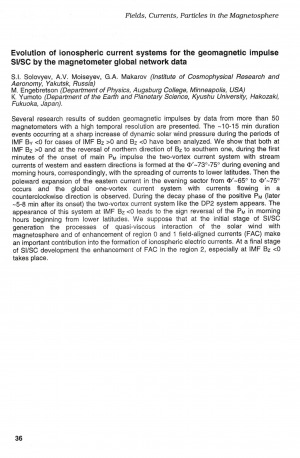
Evolution of ionospheric current systems for the geomagnetic impulse SI/SC by the magnetometer global network data : [тезисы докладов] / S. I. Solovyev, A. V. Moiseyev, M. Engebretson, K. Yumoto // Physics of auroral phenomena : 24 annual seminar, 27 February - 2 March 2001. – 2001. – P. 36.
Количество страниц: 2 с.
- Математика. Естественные науки > Астрономия. Астрофизика. Исследование космического пространства. Геодезия,
- Математика. Естественные науки > Геология. Геологические и геофизические науки,
- НАУКА ЯКУТИИ > МАТЕМАТИКА. ЕСТЕСТВЕННЫЕ НАУКИ > Астрономия. Астрофизика. Исследование космического пространства. Геодезия,
- НАУКА ЯКУТИИ > МАТЕМАТИКА. ЕСТЕСТВЕННЫЕ НАУКИ > Геология. Геологические и геофизические науки.
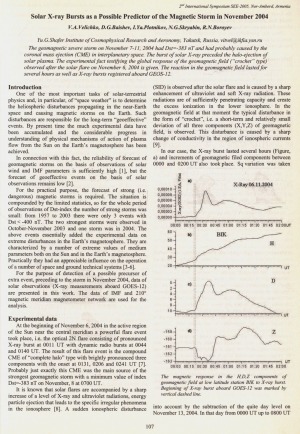
Solar X-ray Bursts as a Possible Predictor of the Magnetic Storm in November 2004 / V. A. Velichko, D. G. Baishev, I. Ya. Plotnikov, N. G. Skryabin, R. N. Boroev // Solar Extreme Events Fundamental Science and Applied Aspects Nor-Amberd, Armenia 26-30 September 2005 : proceedings of the Second International Symposium / edited by A. Chilingarian and G. Karapetyan. − Erevan : Cosmic Ray Division, Alikhanyan Physics Institute, 2006. − P. 107-108.
Количество страниц: 4 с.
- Математика. Естественные науки > Астрономия. Астрофизика. Исследование космического пространства. Геодезия,
- Математика. Естественные науки > Геология. Геологические и геофизические науки,
- НАУКА ЯКУТИИ > МАТЕМАТИКА. ЕСТЕСТВЕННЫЕ НАУКИ > Астрономия. Астрофизика. Исследование космического пространства. Геодезия,
- НАУКА ЯКУТИИ > МАТЕМАТИКА. ЕСТЕСТВЕННЫЕ НАУКИ > Геология. Геологические и геофизические науки.
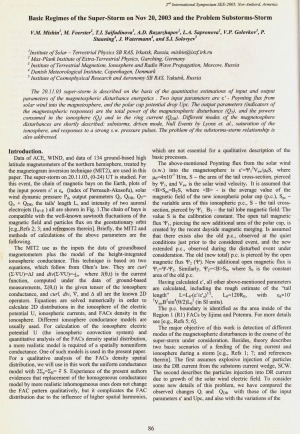
Basic Regimes of the Super-Storm on Nov 20, 2003 and the Problems Substorms-Storm / V. M. Mishin, M. Foerster, T. I. Saifudinova, A. D. Bazarzhapov, L. A. Sapronova, V. P. Golovkov, P. Stauning, J. Watermann, and S. I. Solovyev // Solar Extreme Events Fundamental Science and Applied Aspects Nor-Amberd, Armenia 26-30 September 2005 : proceedings of the Second International Symposium / edited by A. Chilingarian and G. Karapetyan. − Erevan : Cosmic Ray Division, Alikhanyan Physics Institute, 2006. − P. 86-89.
Количество страниц: 3 с.
- Математика. Естественные науки > Астрономия. Астрофизика. Исследование космического пространства. Геодезия,
- Математика. Естественные науки > Геология. Геологические и геофизические науки,
- Прикладные науки. Медицина. Ветеринария. Техника. Сельское хозяйство > Инженерное дело. Техника в целом,
- НАУКА ЯКУТИИ > МАТЕМАТИКА. ЕСТЕСТВЕННЫЕ НАУКИ > Астрономия. Астрофизика. Исследование космического пространства. Геодезия,
- НАУКА ЯКУТИИ > ПРИКЛАДНЫЕ НАУКИ. МЕДИЦИНА. ТЕХНИКА. СЕЛЬСКОЕ ХОЗЯЙСТВО > Инженерное дело. Техника в целом,
- НАУКА ЯКУТИИ > МАТЕМАТИКА. ЕСТЕСТВЕННЫЕ НАУКИ > Геология. Геологические и геофизические науки.
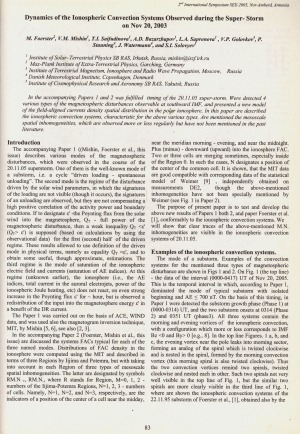
Dynamics of the Ionospheric Convection Systems Observed during The Super-Storm on Nov. 20, 2003 / M. Foerster, V. M. Mishin, T. I. Saifudinova, A. D. Bazarzhapov, L. A. Sapronova, V. P. Golovkov, P. Stauning, J. Watermann, and S. I. Solovyev // Solar Extreme Events Fundamental Science and Applied Aspects Nor-Amberd, Armenia 26-30 September 2005 : proceedings of the Second International Symposium / edited by A. Chilingarian and G. Karapetyan. − Erevan : Cosmic Ray Division, Alikhanyan Physics Institute, 2006. − P. 83-85.
Количество страниц: 4 с.
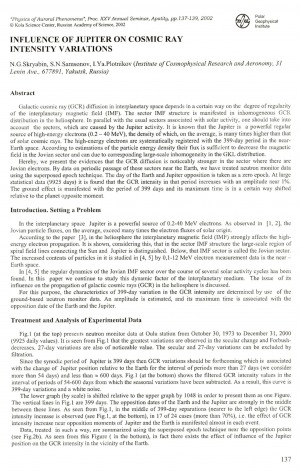
Skryabin, N. G. Influence of Jupiter on cosmic ray intensity variations / N. G. Skryabin, S. N. Samsonov, I. Ya. Plotnikov // Physics of auroral phenomena : proceedings of the 25th annual seminar, Apatity, 26 February – 1 March 2002. – 2002. – P. 137-139.
Количество страниц: 14 с.
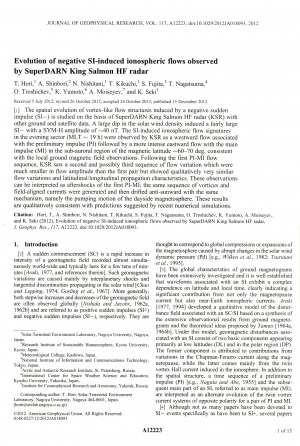
Evolution of negative SI-induced ionospheric flows observed by SuperDARN King Salmon HF radar / T. Hori, A. Shinbori, N. Nishitani, T. Kikuchi, S. Fujita, T. Nagatsuma, O. Troshichev, K. Yumoto, A. Moiseyev, and K. Seki // Journal of Geophysical Research: Space Physics. – 1978. – 2012 (December), vol. 117, N 12. – P. A12223.
DOI: 10.1029/2012JA018093