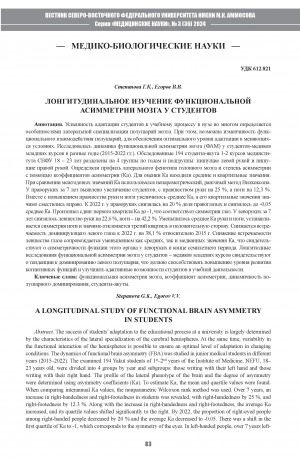
Лонгитудинальное изучение функциональной асимметрии мозга у студентов = A longitudinal study of functional brain asymmetry in students
Статья в журнале
Русский
612.821-057.87
функциональная асимметрия мозга; коэффициент асимметрии; динамичность полушарного доминирования; студенты-якуты; functional asymmetry of the brain; asymmetry coefficient; hemispheric dominance dynamics; Yakut students
C. 83-90
Вестник Северо-Восточного федерального университета им. М. К. Аммосова = Vestnik of North-Eastern Federal Univercity: электронное научное периодическое издание
Якутск, Издательский дом СВФУ
Издается с 2015 г.
Выходит 4 раза в год
2587-5590 (online)
Вестник Северо-Восточного федерального университета им. М. К. Аммосова. Серия "Медицинские науки" : электронное научное периодическое издание / Федеральное государственное автономное образовательное учреждение высшего профессионального образования "Северо-Восточный федеральный университет имени М. К. Аммосова" ; главный редактор: А. Н. Николаев. — Якутск : Издательский дом СВФУ, 2015 —. 2024, N 3 (36). – 90 с.
The success of students’ adaptation to the educational process at a university is largely determined by the characteristics of the lateral specialization of the cerebral hemispheres. At the same time, variability in the functional interaction of the hemispheres is possible to ensure an optimal level of adaptation in changing conditions. The dynamics of functional brain asymmetry (FBA) was studied in junior medical students in different years (2015-2022). The examined 194 Yakut students of 1st-2nd years of the Institute of Medicine, NEFU, 18-23 years old, were divided into 4 groups by year and subgroups: those writing with their left hand and those writing with their right hand. The profile of the lateral phenotype of the brain and the degree of asymmetry were determined using asymmetry coefficients (Ka). To estimate Ka, the mean and quartile values were found. When comparing interannual Ka values, the nonparametric Wilcoxon rank method was used. Over 7 years, an increase in right-handedness and right-footedness in students was revealed, with right-handedness by 25 %, and right-footedness by 12.3 %. Along with the increase in right-handedness and right-footedness, the average Ka increased, and its quartile values shifted significantly to the right. By 2022, the proportion of right-eyed people among right-handed people decreased by 20 % and the average Ka decreased to -0.05. There was a shift in the first quartile of Ka to -1, which corresponds to the symmetry of the eyes. In left-handed people, over 7 years left-handedness decreased by 22.6 %, and left-footedness - by 42.2 %. The average Ka of the arms and legs decreased, the symmetry of the leg was established and the third quartile significantly deviated in the positive direction. The incidence of the dominant left eye decreased by 2022 by 38.1 % compared to 2015. The decrease in the incidence of left-eyedness is accompanied by a decrease in both the average and median values of Ka, which indicates the symmetry of the function of this organ in left-handed people at the end of the seven-year period. Conclusions: Longitudinal studies of functional brain asymmetry in junior medical students indicate a trend towards dominance of the left hemisphere, which should help increase the level of development of cognitive functions and improve the adaptive capabilities of students in educational activities.
Степанова, Г. К. Лонгитудинальное изучение функциональной асимметрии мозга у студентов / Степанова Г. К., Егоров В. В. ; Северо-Восточный федеральный университет им. М. К. Аммосова, Медицинский институт // Вестник Северо-Восточного федерального университета им. М. К. Аммосова. Серия "Медицинские науки". - 2024. - N 3 (36). - C. 83-90.
Войдите в систему, чтобы открыть документ

QR-код документа

Как сканировать QR-код?
Для пользователей Android:
- Скачайте приложение для сканирования QR-кодов (Google Play)
- Откройте скачанное приложение;
- Наведите камеру на QR-код.
Для пользователей iPhone:
- Откройте приложение "Камера";
- Наведите камеру на QR-код;
- Нажмите на всплывающее уведомление.