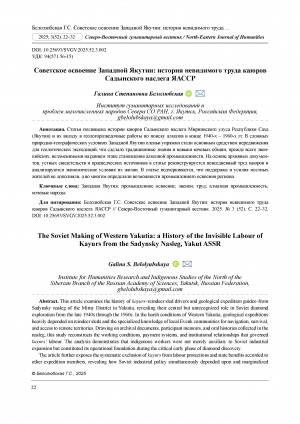
Советское освоение Западной Якутии: история невидимого труда каюров Садынского наслега ЯАССР = The Soviet making of Western Yakutia: а history of the invisible labour of Kayurs from the Sadynsky nasleg, Yakut ASSR
Статья в журнале
Русский
94:622.371(571.56-37)(091)
Западная Якутия; промышленное освоение; эвенки; труд; алмазная промышленность; кочевые народы; Western Yakutia; industrial development; Evenk people; labour; diamond industry; nomadic people
Северо-Восточный гуманитарный вестник. – 2025. – 3 (52) (С. 22-32)
This article examines the history of kayurs-reindeer sled drivers and geological expedition guides-from Sadynsky nasleg of the Mirny District in Yakutia, revealing their central but unrecognized role in Soviet diamond exploration from the late 1940s through the 1960s. In the harsh conditions of Western Yakutia, geological expeditions heavily depended on reindeer sleds and the specialized knowledge of local Evenk communities for navigation, survival, and access to remote territories. Drawing on archival documents, participant memoirs, and oral histories collected in the nasleg, this study reconstructs the working conditions, payment systems, and institutional relationships that governed kayurs' labour. The analysis demonstrates that indigenous workers were not merely auxiliary to Soviet industrial expansion but constituted its operational foundation during the critical early phase of diamond discovery. The article further exposes the systematic exclusion of kayurs from labour protections and state benefits accorded to other expedition members, revealing how Soviet industrial policy simultaneously depended upon and marginalized indigenous expertise. Rather than describing this relationship as ‘participation', the evidence shows that kayurs constituted the irreplaceable force upon which Yakutia's industrial transformation was built.
Белолюбская, Г. С.
Советское освоение Западной Якутии: история невидимого труда каюров Садынского наслега ЯАССР / Г. С. Белолюбская ; Институт гуманитарных исследований и проблем малочисленных народов Севера СО РАН // Северо-Восточный гуманитарный вестник. - 2025. - N 3 (52). - С. 22-32. - DOI: 10.25693/SVGV.2025.52.3.002
DOI: 10.25693/SVGV.2025.52.3.002
- Краеведение. Археология. География. Биографии. История > Историческая наука. Историография > Всеобщая история. История отдельных стран и народов,
- Прикладные науки. Медицина. Ветеринария. Техника. Сельское хозяйство > Инженерное дело. Техника в целом > Горное дело. Горные предприятия (рудники, шахты, карьеры),
- НАУКА ЯКУТИИ > КРАЕВЕДЕНИЕ. ГЕОГРАФИЯ. БИОГРАФИИ. ИСТОРИЯ > Историческая наука. Историография > Всеобщая история,
- НАУКА ЯКУТИИ > ПРИКЛАДНЫЕ НАУКИ. МЕДИЦИНА. ТЕХНИКА. СЕЛЬСКОЕ ХОЗЯЙСТВО > Инженерное дело. Техника в целом > Горное дело. Горные предприятия (рудники, шахты, карьеры).
- 1. Григорьев Степан Алексеевич. Отраслевые научные исследования в Якутии в 1920–1930-е гг. = Industry scientific research in Yakutia in the 1920s – 1930s
- 2. Степанова Лена Борисовна. Визуальная программа исследований Г. В. Ксенофонтова = G. V. Ksenofontov’s visual research program
- 3. Антонов Егор Петрович. К интеллектуальной биографии автора автохтонной концепции этногенеза якутов С. И. Николаева – Сомоготто = To the intellectual biography of S. I. Nikolaev – Somogotto, the author of the autochthonous conception of the Yakuts’ ethnogenesis
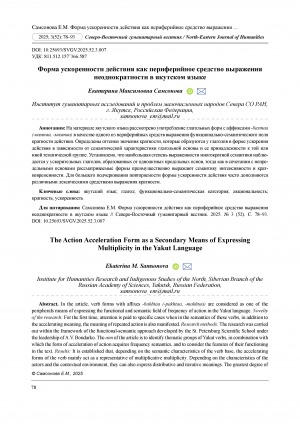
- 4. Самсонова Екатерина Максимовна. Форма ускоренности действия как периферийное средство выражения неоднократности в якутском языке = The action acceleration form as a secondary means of expressing multiplicity in the Yakut language
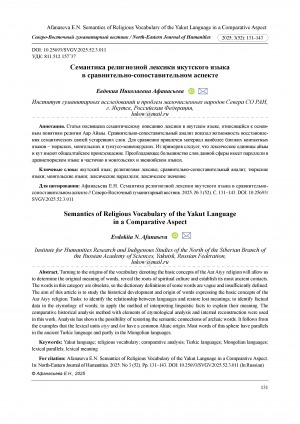
- 5. Афанасьева Евдокия Николаевна. Семантика религиозной лексики якутского языка в сравнительно-сопоставительном аспекте = Semantics of religious vocabulary of the Yakut language in a comparative aspect
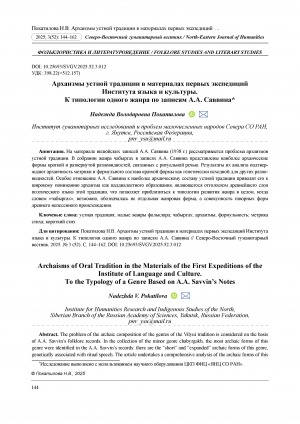
- 6. Покатилова Надежда Володаровна. Архаизмы устной традиции в материалах первых экспедиций Института языка и культуры. К типологии одного жанра по записям А. А. Саввина = Archaisms of oral tradition in the materials of the first expeditions of the Institute of Language and Culture. To the typology of a genre based on A. A. Savvin’s notes
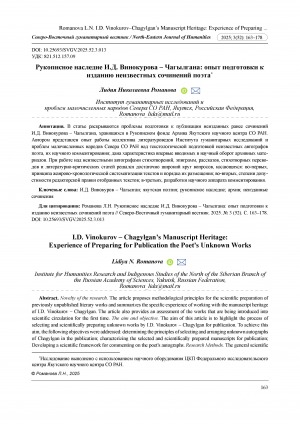
- 7. Романова Лидия Николаевна. Рукописное наследие И. Д. Винокурова – Чагылгана: опыт подготовки к изданию неизвестных сочинений поэта = I. D. Vinokurov – Chagylgan’s manuscript heritage: experience of preparing for publication the poet’s unknown works
- 8. Кошкарева Наталья Борисовна. Функциональная грамматика якутского языка (рецензия на серию монографий "Функционально-семантические категории в якутском языке") = Functional grammar of the Yakut language (review of the monographs’ series “Functional-semantic categories in the Yakut language”)
- 9. Северо-Восточный гуманитарный вестник, 2025, №3 (52)
Войдите в систему, чтобы открыть документ
QR-код документа

Как сканировать QR-код?
Для пользователей Android:
- Скачайте приложение для сканирования QR-кодов (Google Play)
- Откройте скачанное приложение;
- Наведите камеру на QR-код.
Для пользователей iPhone:
- Откройте приложение "Камера";
- Наведите камеру на QR-код;
- Нажмите на всплывающее уведомление.