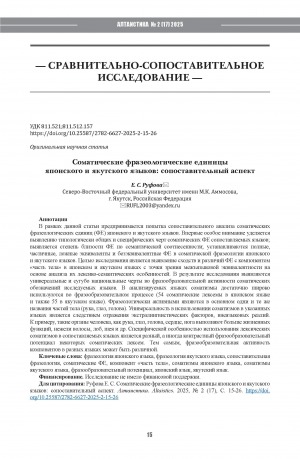
Соматические фразеологические единицы японского и якутского языков: сопоставительный аспект = Somatic phrases of the Japanese and Yakut languages:A comparative aspect
Статья в журнале
Русский
811.521'373.7811.512.157'373.7
10.25587/2782-6627-2025-2-15-26
фразеология японского языка; фразеология якутского языка ; сопоставительная фразеология; соматические ФЕ; компонент "часть тела"; соматизмы японского языка; соматизмы якутского языка; фразообразовательный потенциал; японский язык; якутский язык; phraseology of the Japanese language; phraseology of the Yakut language; comparative phraseology; somatic phraseological units; component “body part”; somatisms of the Japanese language; somatisms of the Yakut language; phrase-formation potential; Japanese language; Yakut language
С. 15-26
Вестник Северо-Восточного федерального университета им. М. К. Аммосова = Vestnik of North-Eastern Federal Univercity: электронное научное периодическое издание
Якутск, Издательский дом СВФУ
Издается с 2021 г.
Выходит 4 раза в год
Вестник Северо-Восточного федерального университета им. М. К. Аммосова. Серия "Алтаистика" : электронное научное периодическое издание / Федеральное государственное автономное образовательное учреждение высшего профессионального образования "Северо-Восточный федеральный университет имени М. К. Аммосова" ; главный редактор: А. Н. Николаев. - Якутск : Издательский дом СВФУ, 2021- . - 2025, N 2 (17). - 83 с.
This article attempts to conduct a comparative analysis of somatic phraseological units (PU) of the Japanese and Yakut languages. For the first time, special attention is paid to identifying typologically common and specific features of somatic PU of the compared languages; the degree of closeness of PU by semantic correlation is revealed; full, partial, false equivalents and non-equivalent PU in the somatic phraseology of the Japanese and Yakut languages reestablished. The aim of the study is to identify similarities and differences between PU with the component “body part” in the Japanese and Yakut languages from the point of view of interlingual equivalence based on the analysis of their lexical and semantic features. As a result of the study, universal and purely national features in the phrase-formation activity of somatic designations of the studied languages are revealed. In the analyzed languages, somatisms are quite widely used in the phrase-formation process (54 somatic lexemes in Japanese and 55 in the Yakut language). Phraseologically active are mainly the same names of body parts (arm, eye, head). The universality in the use of somatisms in the specified languages is a consequence of the reflection of extralinguistic factors, extralinguistic realities. For example, such human organs as arm, eye, head, heart, leg perform more vital functions than hair, forehead, neck, etc. A specific feature of the use of lexical somatisms in the compared languages is the different, and sometimes contrasting, phrase-formation potential of some somatic lexemes. Thus, the phrase-formation activity of components in different languages can be different.
Руфова, Е. С.
Соматические фразеологические единицы японского и якутского языков: сопоставительный аспект / Е. С. Руфова ; Северо-Восточный федеральный университет им. М.К. Аммосова // Вестник Северо-Восточного федерального университета им. М. К. Аммосова. Серия "Алтаистика". - 2025, N 2 (17). - С. 15-26. - DOI: 10.25587/2782-6627-2025-2-15-26
DOI: 10.25587/2782-6627-2025-2-15-26
- Саха тыла/Якутский язык > Научные труды по якутскому языку > Фразеология,
- Языкознание. Филология. Художественная литература > Языкознание и языки. Лингвистика > Якутский (саха),
- Языкознание. Филология. Художественная литература > Языкознание и языки. Лингвистика > Иностранные языки,
- НАУКА ЯКУТИИ > ЯЗЫКОЗНАНИЕ. ФИЛОЛОГИЯ. ЛИТЕРАТУРОВЕДЕНИЕ. ХУДОЖЕСТВЕННАЯ ЛИТЕРАТУРА > Языкознание и языки. Лингвистика.
Войдите в систему, чтобы открыть документ

QR-код документа

Как сканировать QR-код?
Для пользователей Android:
- Скачайте приложение для сканирования QR-кодов (Google Play)
- Откройте скачанное приложение;
- Наведите камеру на QR-код.
Для пользователей iPhone:
- Откройте приложение "Камера";
- Наведите камеру на QR-код;
- Нажмите на всплывающее уведомление.