Количество страниц: 11 с.
- 1. Матвеев Андрей Иннокентьевич, Толстов Александр Васильевич, Петров Игорь Михайлович. Схема создания редкометалльного кластера в Республике Саха (Якутия) = The proposal for developing a rare metal cluster in the Republic of Sakha (Yakutia)
- 2. Данько Михаил Михайлович, Хомутов Артем Валерьевич. Первые результаты мониторинга развития полигонального рельефа в зоне взаимодействия торфяник–озеро на севере Пур-Тазовского междуречья в 2021–2023 гг. = The first results of monitoring the development of polygonal relief in the peatland-lake interaction zone in the Northern Pur-Taz interfluve from 2021 to 2023
- 3. Тананаев Никита Иванович. Подбор оптимальной модели климатического реанализа по годовой сумме осадков для территории Республики Саха (Якутия) = Selection of the best-performing climate reanalysis model for the Republic of Sakha (Yakutia) based on mean annual precipitation
- 4. Новоприезжая Варвара Андреевна, Федоров Александр Николаевич. Изменение геокриологических условий межаласий Центральной Якутии при прогнозируемом потеплении климата = Changes in geocryological conditions in interalas terrain under predicted climate warming, Central Yakutia
- 5. Чжан Сяохун, Николаев Анатолий Николаевич, Арсак Альберто, Колмогоров Алексей Иванович, Васильев Михаил Семенович, Пестрякова Людмила Агафьевна. Климатический отклик радиального роста лиственницы Каяндера и сосны обыкновенной в Центральной Якутии = Climate response in radial growth of Larix cajanderi and Pinus sylvestris in Central Yakutia
- 6. Кузьмина Надежда Петровна, Ермолаева Светлана Валерьевна, Чевычелов Александр Павлович. Микроорганизмы мерзлотных лугово-степных почв Центральной Якутии = Microorganisms in the cryogenic meadow-steppe soils of Central Yakutia
- 7. Сымпилова Дарима Паламовна, Гынинова Аюр Базаровна, Шахматова Екатерина Юрьевна. Почвы на лёссовидных суглинках в сезонномерзлотных ландшафтах Селенгинского среднегорья (Западное Забайкалье) = Soils in loess-like loams within the seasonally frozen landscapes of the Selenga Middle Mountains (Western Transbaikal Region)
- 8. Ермакова Юлия Владимировна, Бурнашева Альбина Петровна. Структура и пространственное распределение сообществ прямокрылых (Orthoptera) таежно-аласных ландшафтов Лено-Амгинского междуречья (Центральная Якутия) = Structure and spatial distribution of communities Orthoptera in the taiga-alas landscapes of the Lena-Amga interfluve (Central Yakutia)
- 9. Кычкин Анатолий Константинович, Кычкин Айсен Анатольевич, Стручков Николай Федорович. Исследование сохранения физико-механических свойств стекло-углепластиков при провокационном биозаражении в условиях холодного климата = The preservation of physical and mechanical properties of glass-carbon composites under provocative biocontamination in cold climate conditions
- 10. Неустроев Ефим Петрович, Прокопьев Айсен Русланович. Обработка быстрым джоулевым нагревом углеродных пленок, сформированных осаждением в плазме метана = Fast Joule heating of carbon films formed by methane plasma deposition
- 11. Копырина Любовь Иннокентьевна, Николаева Надежда Анисимовна. Динамика численности охотничьих видов млекопитающих Якутии в XX веке = The dynamics of hunting mammal species populations in Yakutia during the 20th century
- 12. Природные ресурсы Арктики и Субарктики = Arctic and Subarctic natural resources, 2025, №1 (Т. 30)
- 13. Природные ресурсы Арктики и Субарктики = Arctic and Subarctic natural resources, 2025, №2 (Т. 30)
- 14. Природные ресурсы Арктики и Субарктики = Arctic and Subarctic natural resources, 2025, №3 (Т. 30)
- 15. Природные ресурсы Арктики и Субарктики = Arctic and Subarctic natural resources: научный журнал, 2025, №4 (Т. 30)
An assessment of landscape resilience and hydrobiological research on watercourses was conducted for the first time in the Kular gold-bearing region within the Yana River basin of the Republic of Sakha (Yakutia). This study was prompted by the increasing interest in resuming placer gold mining in these areas, which could potentially harm the natural environment and exacerbate existing ecological issues. To address these potential negative impacts, it is essential to implement effective environmental protection strategies. A key component of this effort involves assessing the current state of the natural environment and thoroughly evaluating the resilience of its ecosystems. The hydrobiological research employed both quantitative and qualitative samples collected from the Suor-Uyalaakh River streams. We assessed landscape resilience using a methodology aimed at understanding how key factors affect landscape stability in the cryolithozone. Additionally, we conducted field and laboratory analyses of algae to identify indicators of species composition, abundance, and biomass in the watercourses of the Suor-Uyalaakh River. The findings revealed low diversity and underdevelopment of algal populations, with diatoms being the dominant group in the phytoplankton and phytoperiphyton communities. In contrast, green algae showed lower diversity, followed by yellow-green algae and Euglena. The evaluation of landscape stability in the region indicated extremely low to low resistance to human impacts, which varied based on the ratio of permafrost to bioclimatic factors. The data collected can serve as a basis for creating a biomonitoring database, particularly in light of the increasing human pressures on the aquatic ecosystems of the Suor-Uyalaakh River in Northeast Yakutia. Assessing the resilience of landscapes in the Kular goldbearing deposits may be practically significant for formulating ecological regulations and implementing environmental protection measures to mitigate adverse effects on the natural environment
Копырина, Л. И.
Устойчивость ландшафтов и современное состояние фитопланктона водотоков Куларского золотоносного района / Л. И. Копырина, Н. А. Николаева ; Институт биологических проблем криолитозоны СО РАН, Институт физико-техническихпроблем Севера им. В. П. Ларионова СО РАН // Природные ресурсы Арктики и Субарктики. - 2025. - N 1, Т. 30. - С. 119-129. - DOI: 10.31242/2618-9712-2025-30-1-119-129
DOI: 10.31242/2618-9712-2025-30-1-119-129
Количество страниц: 12 с.
- 1. Матвеев Андрей Иннокентьевич, Толстов Александр Васильевич, Петров Игорь Михайлович. Схема создания редкометалльного кластера в Республике Саха (Якутия) = The proposal for developing a rare metal cluster in the Republic of Sakha (Yakutia)
- 2. Данько Михаил Михайлович, Хомутов Артем Валерьевич. Первые результаты мониторинга развития полигонального рельефа в зоне взаимодействия торфяник–озеро на севере Пур-Тазовского междуречья в 2021–2023 гг. = The first results of monitoring the development of polygonal relief in the peatland-lake interaction zone in the Northern Pur-Taz interfluve from 2021 to 2023
- 3. Тананаев Никита Иванович. Подбор оптимальной модели климатического реанализа по годовой сумме осадков для территории Республики Саха (Якутия) = Selection of the best-performing climate reanalysis model for the Republic of Sakha (Yakutia) based on mean annual precipitation
- 4. Новоприезжая Варвара Андреевна, Федоров Александр Николаевич. Изменение геокриологических условий межаласий Центральной Якутии при прогнозируемом потеплении климата = Changes in geocryological conditions in interalas terrain under predicted climate warming, Central Yakutia
- 5. Кузьмина Надежда Петровна, Ермолаева Светлана Валерьевна, Чевычелов Александр Павлович. Микроорганизмы мерзлотных лугово-степных почв Центральной Якутии = Microorganisms in the cryogenic meadow-steppe soils of Central Yakutia
- 6. Сымпилова Дарима Паламовна, Гынинова Аюр Базаровна, Шахматова Екатерина Юрьевна. Почвы на лёссовидных суглинках в сезонномерзлотных ландшафтах Селенгинского среднегорья (Западное Забайкалье) = Soils in loess-like loams within the seasonally frozen landscapes of the Selenga Middle Mountains (Western Transbaikal Region)
- 7. Копырина Любовь Иннокентьевна, Николаева Надежда Анисимовна. Устойчивость ландшафтов и современное состояние фитопланктона водотоков Куларского золотоносного района = Landscape resilience and the modern state of phytoplanktonin the streams of the Kularsky gold-bearing region
- 8. Ермакова Юлия Владимировна, Бурнашева Альбина Петровна. Структура и пространственное распределение сообществ прямокрылых (Orthoptera) таежно-аласных ландшафтов Лено-Амгинского междуречья (Центральная Якутия) = Structure and spatial distribution of communities Orthoptera in the taiga-alas landscapes of the Lena-Amga interfluve (Central Yakutia)
- 9. Кычкин Анатолий Константинович, Кычкин Айсен Анатольевич, Стручков Николай Федорович. Исследование сохранения физико-механических свойств стекло-углепластиков при провокационном биозаражении в условиях холодного климата = The preservation of physical and mechanical properties of glass-carbon composites under provocative biocontamination in cold climate conditions
- 10. Неустроев Ефим Петрович, Прокопьев Айсен Русланович. Обработка быстрым джоулевым нагревом углеродных пленок, сформированных осаждением в плазме метана = Fast Joule heating of carbon films formed by methane plasma deposition
- 11. Копырина Любовь Иннокентьевна, Николаева Надежда Анисимовна. Динамика численности охотничьих видов млекопитающих Якутии в XX веке = The dynamics of hunting mammal species populations in Yakutia during the 20th century
- 12. Природные ресурсы Арктики и Субарктики = Arctic and Subarctic natural resources, 2025, №1 (Т. 30)
- 13. Природные ресурсы Арктики и Субарктики = Arctic and Subarctic natural resources, 2025, №2 (Т. 30)
- 14. Природные ресурсы Арктики и Субарктики = Arctic and Subarctic natural resources, 2025, №3 (Т. 30)
- 15. Природные ресурсы Арктики и Субарктики = Arctic and Subarctic natural resources: научный журнал, 2025, №4 (Т. 30)
Climate change, characterized by increased temperature fluctuations and alterations in precipitation and soil moisture conditions, can significantly impact ecosystems that experience both moisture deficits and excesses. Even small changes in precipitation and air temperature can significantly affect tree growth. This paper examines the statistical parameters of the width of annual rings and the results of dendroclimatic analysis of larch (Larix cajanderi Mayr.) and pine (Pinus sylvestris L.) growing in the zone of continuous permafrost. The forest areas where larch and pine samples were collected are located near the village of Magan and the urban-type settlement of Nizhny Bestyakh in the central part of the Republic of Sakha (Yakutia). Woody plants are characterized by a longlife cycle, the annual rings of which are able to store information about their growth. This important resource allows obtaining valuable information about the climate and environmental changes in a given area. To understand how trees respond to climate change, Pearson correlation coefficients were calculated between the width of tree rings and average monthly air temperature, annual precipitation, and the SPEI aridity index using data from the Yakutsk weather station. To identify the response of different tree species to climate change over the past 30 years, each year was considered as a separate period. We assume that air temperature, which tends to increase, is one of the limiting factors that affects precipitation and dry periods. Due to the lack of moisture in the form of rain, tree species experience difficulties. They mainly receive moisture from the active layer of permafrost, which accumulates autumn precipitation of the previous year. Overall, we observe a negative response to the increase in air temperature in the surface layer of the atmosphere. On one hand, this suggests a decline in the radial growth of larch and pine; on the other hand, tree species are adapting to the changing climatic conditions in the central region of Yakutia
Климатический отклик радиального роста лиственницы Каяндера и сосны обыкновенной в Центральной Якутии / Чжан Сяохун, А. Н. Николаев, А. Арсак, А. И. Колмогоров, М. С. Васильев, Л. А. Пестрякова ; Северо-Восточный федеральный университет им. М. К. Аммосова, Сибирский федеральный университет, Институт мерзлотоведения им. П. И. Мельникова СО РАН // Природные ресурсы Арктики и Субарктики. - 2025. - N 1, Т. 30. - С. 85-96. - DOI: 10.31242/2618-9712-2025-30-1-85-96
DOI: 10.31242/2618-9712-2025-30-1-85-96
Количество страниц: 10 с.
- 1. Чудинов Павел Леонидович, Фридовский Валерий Юрьевич. Применение алгоритмов машинного обучения для прогнозирования золоторудной минерализации Верхнеамгинского щелочного массива, Алдано-Становой щит = Application of machine learning algorithms to predict gold mineralizationin the Verkhneamginsky alkaline massif, Aldan-Stanovoy Shield
- 2. Сукнев Сергей Викторович. Влияние условий водонасыщения на прочность карбонатных пород при сжатии = Influence of water saturation conditions on the compressive strength of carbonate rocks
- 3. Андреева Сахая Николаевна. Стратегии жизни плотнодерновинных злаков Festuca lenensis Drob. и Koeleria cristata (L.) Pers. в степных сообществах Центральной Якутии = The life strategies of firm-bunch grasses Festuca lenensis Drob. and Koeleria cristata (L.) Pers. in the steppe communities of Central Yakutia
- 4. Боескоров Василий Степанович, Саввинов Григорий Николаевич. Ископаемые остатки мезофауны четвертичного периода Янского плато как индикаторы палеоландшафтных условий позднего плейстоцена = Fossil specimens of the mesofauna from the Quaternary period of the Yana Plateau as indicators of the paleolandscape conditions during the late Pleistocene
- 5. Жуков Михаил Андреевич. Вопросы реализации Национального проекта "Биоэкономика" в Арктической зоне Российской Федерации = Issues with implementation regarding the National Project “Bioeconomics” in the Arctic zone of the Russian Federation
- 6. Кершенгольц Борис Моисеевич. Национальный проект России "Биоэкономика" на Северо-Востоке Евразии: биопрепараты из тканей холодоадаптированных дикоросов и аборигенных видов животных = National project of Russia “Bioeconomics” in the North-East of Eurasia: biopreparations from tissues of cold-adapted wild plants and native animal species
- 7. Васильев Андрей Петрович, Охлопкова Айталина Алексеевна, Стручкова Татьяна Семеновна, Алексеев Алексей Гаврильевич. Влияние механохимической активации диоксида церия на структуру и свойства политетрафторэтилена = Effect of mechanochemical activation of cerium dioxide on the structure and properties of polytetrafluoroethylene
- 8. Ксю Мингсян, Гоголева Ольга Владимировна, Соколова Марина Дмитриевна, Петрова Павлина Николаевна, Федоров Андрей Леонидович, Кондаков Михаил Николаевич, Чжан Дайфен. Исследование изменения свойств СВМПЭ в натурных условиях г. Якутск в зависимости от сезона экспонирования = Study of the changes in the properties of UHMWPE under the natural environmental conditions of Yakutsk based on seasonal exposure
- 9. Природные ресурсы Арктики и Субарктики = Arctic and Subarctic natural resources, 2025, №2 (Т. 30)
This paper presents a chemotaxonomic investigation of three larch species: Cajander larch (Larix cajanderi), Siberian larch (Larix sibirica), and Gmelin larch (Larix gmelinii). We examined the metabolomic profiles obtained through gas chromatography coupled with mass spectrometry detector of various plant organs, including needles, bark, and cones of Larix sibirica, Larix gmelinii, and Larix cajanderi. The objective of this study was to identify species-specific biochemical characteristics and their correlation with environmental growth conditions. Plant samples were collected under controlled conditions from the Botanical Garden of the Institute for Biological Problems of Cryolithozone SB RAS. The results of our study indicate that L. gmelinii and L. cajanderi share similar metabolic profiles, as revealed by principal component analysis (PCA). This finding suggests a biochemical similarity between the two species, which may reflect their related ecological adaptations to the environmental conditions of Central Yakutia. In contrast, Larix sibirica was observed to form a distinct cluster, thereby confirming its unique identity and differences in metabolic profile. The metabolomic analysis indicated that environmental factors, including soil conditions, humidity, and temperature, have a more pronounced impact on the chemical composition of the needles and bark of these species than their taxonomic distinctions. These results highlight the importance of considering environmental factors when investigating the taxonomy and differentiation of Larix species. Furthermore, this research opens new avenues for further exploration in the field of environmental biochemistry concerning coniferous woody plants. This study may serve as a foundational reference for future investigations into metabolomics and chemotaxonomy in relation to plant adaptation to changing environmental conditions.
Рожина, С. М.
Хемотаксономические исследования деревьев рода Larix на территории Центральной Якутии / С. М. Рожина, А. А. Местникова, И. В. Cлепцов ; Институт биологических проблем криолитозоны СО РАН // Природные ресурсы Арктики и Субарктики. - 2025. - N 2, Т. 30. - С. 250-259. - DOI: 10.31242/2618-9712-2025-30-2-250-259
DOI: 10.31242/2618-9712-2025-30-2-250-259
Количество страниц: 12 с.
- Математика. Естественные науки > Ботаника,
- Прикладные науки. Медицина. Ветеринария. Техника. Сельское хозяйство > Сельское хозяйство. Лесное хозяйство. Охота. Рыболовное хозяйство,
- НАУКА ЯКУТИИ > ПРИКЛАДНЫЕ НАУКИ. МЕДИЦИНА. ТЕХНИКА. СЕЛЬСКОЕ ХОЗЯЙСТВО > Сельское хозяйство. Лесное хозяйство. Охота. Рыболовное хозяйство,
- НАУКА ЯКУТИИ > МАТЕМАТИКА. ЕСТЕСТВЕННЫЕ НАУКИ > Ботаника.
- 1. Чудинов Павел Леонидович, Фридовский Валерий Юрьевич. Применение алгоритмов машинного обучения для прогнозирования золоторудной минерализации Верхнеамгинского щелочного массива, Алдано-Становой щит = Application of machine learning algorithms to predict gold mineralizationin the Verkhneamginsky alkaline massif, Aldan-Stanovoy Shield
- 2. Сукнев Сергей Викторович. Влияние условий водонасыщения на прочность карбонатных пород при сжатии = Influence of water saturation conditions on the compressive strength of carbonate rocks
- 3. Рожина Сахаяна Михайловна, Местникова Анна Александровна, Cлепцов Игорь Витальевич. Хемотаксономические исследования деревьев рода Larix на территории Центральной Якутии = Chemotaxonomic investigations of Larix species in Central Yakutia
- 4. Боескоров Василий Степанович, Саввинов Григорий Николаевич. Ископаемые остатки мезофауны четвертичного периода Янского плато как индикаторы палеоландшафтных условий позднего плейстоцена = Fossil specimens of the mesofauna from the Quaternary period of the Yana Plateau as indicators of the paleolandscape conditions during the late Pleistocene
- 5. Жуков Михаил Андреевич. Вопросы реализации Национального проекта "Биоэкономика" в Арктической зоне Российской Федерации = Issues with implementation regarding the National Project “Bioeconomics” in the Arctic zone of the Russian Federation
- 6. Кершенгольц Борис Моисеевич. Национальный проект России "Биоэкономика" на Северо-Востоке Евразии: биопрепараты из тканей холодоадаптированных дикоросов и аборигенных видов животных = National project of Russia “Bioeconomics” in the North-East of Eurasia: biopreparations from tissues of cold-adapted wild plants and native animal species
- 7. Васильев Андрей Петрович, Охлопкова Айталина Алексеевна, Стручкова Татьяна Семеновна, Алексеев Алексей Гаврильевич. Влияние механохимической активации диоксида церия на структуру и свойства политетрафторэтилена = Effect of mechanochemical activation of cerium dioxide on the structure and properties of polytetrafluoroethylene
- 8. Ксю Мингсян, Гоголева Ольга Владимировна, Соколова Марина Дмитриевна, Петрова Павлина Николаевна, Федоров Андрей Леонидович, Кондаков Михаил Николаевич, Чжан Дайфен. Исследование изменения свойств СВМПЭ в натурных условиях г. Якутск в зависимости от сезона экспонирования = Study of the changes in the properties of UHMWPE under the natural environmental conditions of Yakutsk based on seasonal exposure
- 9. Природные ресурсы Арктики и Субарктики = Arctic and Subarctic natural resources, 2025, №2 (Т. 30)
An evaluation of the life strategies of firm-bunch grasses, namely Festuca lenensis and Koeleria cristata, was conducted within the steppe ecosystems of Central Yakutia, using established ecological and phytocenotic strategies. These strategies classify plant species into three groups: competitors, stress-tolerants, and ruderals, commonly referred to as CSR strategies. Each group is defined by a distinct set of adaptive ontogenetic and population characteristics. A comprehensive assessment of various adaptive population indicators was performed, including density, recovery index, aging index, basic spectrum, types of regenerative strategy, and vitality structure. The study included 21 cenopopulations of Festuca lenensis and 12 cenopopulations of Koeleria cristata. Consequently, the ecological conditions of the communities were analyzed using ecological scales, considering the impact of several factors: moisture, soil salinity, and pasture degradation. In the valley of the middle reaches of the Lena River, Festuca lenensis was observed to thrive within the following ranges: at moisture levels of 56.0-59.0, soil salinity levels of 10.4-11.4, and pasture degradation levels of 3.8-4.5. Conversely, communities containing Koeleria cristata were associated with moisture levels of 54.5-59.0, soil salinity levels of 10.4-12.2, and pasture degradation levels of 4.2-4.5. Furthermore, distinct life strategies were identified for both Festuca lenensis and Koeleriacristata. The ecological and phytocenotic strategy of Festuca lenensis is representative of low-bunch grasses found in unproductive communities, aligning with the CSR strategies. In contrast, Koeleriacristata demonstrates an S strategy. In conclusion, the life strategies of both Festuca lenensis and Koeleriacristata, shaped by their distinct adaptive responses of population indicators to comparable ecological and phytocenotic conditions, enable their successful coexistence within the changing environments of the relict steppe communities in Central Yakutia.
Андреева, С. Н.
Стратегии жизни плотнодерновинных злаков Festuca lenensis Drob. и Koeleria cristata (L.) Pers. в степных сообществах Центральной Якутии / С. Н. Андреева ; Институт биологических проблем криолитозоны СО РАН // Природные ресурсы Арктики и Субарктики. - 2025. - N 2, Т. 30. - С. 238-249. - DOI: 10.31242/2618-9712-2025-30-2-238-249
DOI: 10.31242/2618-9712-2025-30-2-238-249
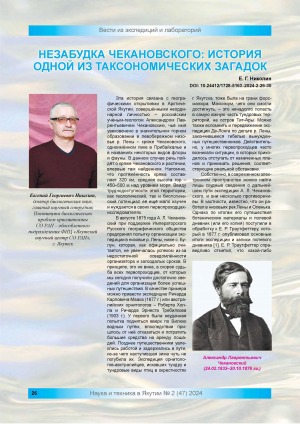
Количество страниц: 5 с.
- 1. Колодезников Игорь Иннокентьевич. Впечатления об удивительной книге
- 2. Лепов Валерий Валерьевич, Пудов Алексей Григорьевич. Идеология и будущее Республики Саха (Якутия) в государстве-цивилизации
- 3. Балакшин Георгий Дмитриевич. О якутском цикле стихотворений Евгения Евтушенко
- 4. Алексеев Владимир Романович. Холод и жизнь
- 5. Семенова Варвара Васильевна. Воссоздание традиционного кисломолочного продукта тара народа саха в современных условиях
- 6. Слодкевич Евгений Яковлевич, Находкин Николай Александрович. Совершенствование системы информирования населения о ЧС в Якутии на основе коротковолновой радиосвязи
- 7. Черосов Михаил Михайлович, Алексеева Ньургустана Михайловна. К 110-летию Георгия Павловича Коротова
- 8. Чаунина Наталья Владимировна. Итоги международной научно-практической конференции молодых учёных, аспирантов и студентов в г. Нерюнгри
- 9. Лепов Валерий Валерьевич, Голых Роман Николаевич. Конференция по математическому моделированию и автоматизации в наукограде Бийске
- 10. Кершенгольц Борис Моисеевич. О наиболее эволюционно древней рецепторно-регуляторной водосодержащей системе в организмах многоклеточных
- 11. Жукова Людмила Николаевна. Шаманские традиции лесных юкагиров в конце XIX – конце XX вв.
- 12. Киселев Валерий Васильевич. О становлении горной науки в Якутии
- 13. Данилова Вера Софроновна. Некоторые аспекты методологии исследования произведений искусства
- 14. Лепов Валерий Валерьевич. Международные усилия в области создания умных материалов
- 15. Сериков Сергей Иванович. Игарская геокриологическая лаборатория Института мерзлотоведения им. П. И. Мельникова СО РАН
- 16. Находкин Николай Александрович. Где находится земля Санникова?
- 17. Наука и техника в Якутии, 2024, №2 (47)
Николин, Е. Г. Незабудка Чекановского: история одной из таксономических загадок / Е. Г. Николин ; Институт биологических проблем криолитозоны СО РАН // Наука и техника в Якутии. - 2024. - N 2 (47). - C. 26-30. - DOI: 10.24412/1728-516Х-2024-2-26-30
DOI: 10.24412/1728-516Х-2024-2-26-30

Количество страниц: 13 с.
- 1. Колесова Лена Афанасьевна, Соловьева Марианна Иннокентьевна. Биоморфологическая изменчивость Allium splendens Willd. ex Schult. в условиях Центральной Якутии = Biomorphological variability of Allium splendens Willd. ex Schult. in the conditions of Central Yakutia
- 2. Bahel Benjamin, Yamb Emmanuel , Ngwem Blaise, Kenmogne Fabien, Kum Robert A., Safonova Mariya N., Fedotov Andrey A., Ammosova Nyurguyana E.. Mechanical behaviour of compressed earth blocks reinforced with random and aligned continuous distribution corn husk fibers = Механическое воздействие прессованных грунтовых блоков, армированных волокнами кукурузной шелухи с хаотичным непрерывным распределением
- 3. Васильева Акулина Александровна. Язык саха в сфере государственного и муниципального управления глазами служащих и населения г. Якутска Республики Саха (Якутия) = The Sakha language in state and municipal administration from the perspective of officials and the people of the Sakha Republic (Yakutia)
- 4. Сивцева-Максимова Прасковья Васильевна. Поэма А. Е. Кулаковского "Сон шамана": опыт анализа в аспекте проблем текстологии = Alexei Kulakovsky’s poem “The Shaman’s Dream”: an analysis focusing on textual criticism aspects
- 5. Рахлеева Айталина Владимировна. Семантика и прототипы образной светоцветовой лексики якутского языка = Semantics and prototypes of figurative light and color terms in the Yakut language
- 6. Титов Яков Нестерович. Перевод пьесы "Ночь Гельвера" И. Вилквистана якутский язык: анализ собственного перевода = Translating Ingmar Villqist’s “Helver’s Night” into Yakut: an analysis of a translation experience
- 7. Семенова Ирина Гаврильевна, Окорокова Варвара Гавриловна, Семенов Сергей Иннокентьевич, Окорокова Варвара Борисовна, Семенова Валентина Григорьевна. К юбилею ученого, литературного критика, педагога ЯГУ-СВФУ Гаврила Гавриловича Окорокова (1925–1990) = To the anniversary of Gavril Gavrilovich Okorokov (1925-1990), scientist, literary critic, academic of YSU-NEFU
- 8. Тарабукина Марфа Васильевна. Связующая нить поколений = The intergenerational thread
- 9. Вестник Северо-Восточного федерального университета им. М. К. Аммосова, 2025, №1 (99)
- 10. Вестник Северо-Восточного федерального университета им. М. К. Аммосова, 2025, №2 (100)
- 11. Вестник Северо-Восточного федерального университета им. М. К. Аммосова, 2025, №3 (101)
Historically, the Sakha people used plants in large quantities in their daily diet. According to A. Savvin’s list, there are 76 species of wild food plants used, representing 4% of the flora of Yakutia. However, 11 of these species remain unresolved and are exclusively referenced by Yakut names. Based on preliminary assessment, the plant kus tyla from this list has been identified as Lemna trisulca and the Lemnaceae family. A. Savvin’s list indicates that 59 species, representing 42 genera and 23 families, were used by Sakha people in fermented milk products and dishes. The families Rosaceae (7), Polygonaceae (6), Alliaceae (4), Ericaceae (4), and Asteraceae (4) are the most prominent in the dataset. The biomorphological spectrum of these 59 plant species includes 3 tree species, 9 shrubs species, and 3 dwarf shrub species, with the remaining species classified as perennial herbaceous plants. To continue research on food plants, the species list has to be consistent with modern scientific classification. This study identified 15 species, with 4 species reclassified to the level of genera. The identification of certain species, including Saussurea amara, Rheum rhaponticum, and Allium senescens, involved a comparative analysis of data from other sources. Traditionally, the Sakha people prepared diverse fermented milk products and dishes with the addition of plant ingredients, including leaves, roots and berries. Fermented milk soups, such as ас and үөрэ, exhibited the greatest botanical diversity, with up to 35 plant species were used in preparation. The sweet taste of the dishes kyobyuyor, dagda, kyuorchekh was given by the roots and berries of plants.
Семенова, В. В.
Пищевые растения, используемые в традиционных молочнокислых продуктах и блюдах народа саха / В. В. Семенова ; Институт биологических проблем криолитозоны СО РАН // Вестник Северо-Восточного федерального университета им. М. К. Аммосова. - 2025. - Т. 22, N 1 (99). - С. 16-28. - DOI: 10.25587/2222-5404-2025-22-1-16-28
DOI: 10.25587/2222-5404-2025-22-1-16-28

Количество страниц: 9 с.
- 1. Семенова Варвара Васильевна. Пищевые растения, используемые в традиционных молочнокислых продуктах и блюдах народа саха = Food plants used in traditional fermented milk products and dishes of the Sakha people
- 2. Bahel Benjamin, Yamb Emmanuel , Ngwem Blaise, Kenmogne Fabien, Kum Robert A., Safonova Mariya N., Fedotov Andrey A., Ammosova Nyurguyana E.. Mechanical behaviour of compressed earth blocks reinforced with random and aligned continuous distribution corn husk fibers = Механическое воздействие прессованных грунтовых блоков, армированных волокнами кукурузной шелухи с хаотичным непрерывным распределением
- 3. Васильева Акулина Александровна. Язык саха в сфере государственного и муниципального управления глазами служащих и населения г. Якутска Республики Саха (Якутия) = The Sakha language in state and municipal administration from the perspective of officials and the people of the Sakha Republic (Yakutia)
- 4. Сивцева-Максимова Прасковья Васильевна. Поэма А. Е. Кулаковского "Сон шамана": опыт анализа в аспекте проблем текстологии = Alexei Kulakovsky’s poem “The Shaman’s Dream”: an analysis focusing on textual criticism aspects
- 5. Рахлеева Айталина Владимировна. Семантика и прототипы образной светоцветовой лексики якутского языка = Semantics and prototypes of figurative light and color terms in the Yakut language
- 6. Титов Яков Нестерович. Перевод пьесы "Ночь Гельвера" И. Вилквистана якутский язык: анализ собственного перевода = Translating Ingmar Villqist’s “Helver’s Night” into Yakut: an analysis of a translation experience
- 7. Семенова Ирина Гаврильевна, Окорокова Варвара Гавриловна, Семенов Сергей Иннокентьевич, Окорокова Варвара Борисовна, Семенова Валентина Григорьевна. К юбилею ученого, литературного критика, педагога ЯГУ-СВФУ Гаврила Гавриловича Окорокова (1925–1990) = To the anniversary of Gavril Gavrilovich Okorokov (1925-1990), scientist, literary critic, academic of YSU-NEFU
- 8. Тарабукина Марфа Васильевна. Связующая нить поколений = The intergenerational thread
- 9. Вестник Северо-Восточного федерального университета им. М. К. Аммосова, 2025, №1 (99)
- 10. Вестник Северо-Восточного федерального университета им. М. К. Аммосова, 2025, №2 (100)
- 11. Вестник Северо-Восточного федерального университета им. М. К. Аммосова, 2025, №3 (101)
The features of different levels of anthropogenic impact on the biomorphological variability of vegetative organs of Allium splendens Willd. ex Schult. in the conditions of Central Yakutia are considered. The biological material for the study was collected in three geographically homogeneous growing areas in Central Yakutia with different degrees of anthropogenic pressure: in natural conditions with low anthropogenic pressure, in conditions of significant anthropogenic impact and in conditions of private introduction. It has been shown that the degree of anthropogenic pressure can be expressed in adaptive changes in plants, expressed in morphological and biochemical characteristics, the measurable indicators of which can differ significantly from the indicators of plants growing in favorable natural conditions or under optimal conditions of introduction. Morphometric variability of traits demonstrates manifestations of the protective component of variability by increasing variability for plants experiencing high anthropogenic pressure. It has been determined that anthropogenic oppression implements adaptation mechanisms through changes in habitus, in particular, the morphometry of the vegetative mass of leaves; negative environmental conditions cause a change in the ratio of age groups of individuals and a change in the reproduction strategy. In this case, the variability of the ascorbic acid content is more associated with the response to stress, realized through the choice of a reproduction strategy, since the amount of ascorbic acid did not correspond to the sequence of a series of morphometric variability, which can be explained by the dominance of the vegetative method of reproduction, in which biochemical processes actively occur in the underground part of the plant.
Колесова, Л. А.
Биоморфологическая изменчивость Alliums plendens Willd. ex Schult. в условиях Центральной Якутии / Л. А. Колесова, М. И Соловьева ; Северо-Восточный федеральный университет им. М. К. Аммосова // Вестник Северо-Восточного федерального университета им. М. К. Аммосова. - 2025. - Т. 22, N 1 (99). - С. 7-15. - DOI: 10.25587/2222-5404-2025-22-1-7-15
DOI: 10.25587/2222-5404-2025-22-1-7-15

Количество страниц: 11 с.
Changes in the fatty acid composition of phospholipids in buds during the winter-spring period (January-May) were studied in silver birch (Betula pendula Roth) growing in Karelia and Yakutia. Phospholipids were isolated from total lipids using column chromatography, while fatty acids were separated through gas chromatography. The metrics for acyl-lipid desaturase activity were represented by the ratios of stearoyl- (SDR), oleoyl- (ODR), and linoleoyl- (LDR) desaturases. Our findings demonstrate that, regardless of geographical location, the predominant phospholipid fraction during the development of primordia within the bud consists of unsaturated fatty acids. During the period of exogenous bud dormancy, dienoic acids were the most prevalent; however, their share declined by the onset of the growing season, while the proportion of trienoic acids increased. These changes were accompanied by a slight rise in the double bond index. Conversely, the unsaturation index nearly doubled by March, with this change being particularly pronounced in Yakutia. Simultaneously, the SDR and ODR values were high, indirectly indicating the active involvement of ω9 and ω6 desaturases in maintaining the liquid-crystalline state of phospholipids. The LDR value in phospholipids was the lowest, yet it nearly tripled by the onset of the growing season in both Karelia and Yakutia. We hypothesize that the liquid state of phospholipids in the cell membranes of meristematic tissue in the buds of silver birch growing in Karelia and Yakutia during the winter-spring period is sustained by high desaturase activity, with the most significant response to temperature changes observed in acyl-lipid ω3 desaturase. Furthermore, through the course of evolution, silver birch in Yakutia has developed an additional mechanism that involves a pronounced reduction in cell and tissue water content, which also contributes to maintaining an ordered state of phospholipids and their functions, particularly when exposed to extremely low air temperatures and permafrost.
Жирнокислотный состав фосфолипидов в почках березы повислой в зимне-весенний период в условиях Карелии и Якутии / Л. В. Ветчинникова, А. Ф. Титов, Т. Д. Татаринова [и др.] ; Институт леса Карельского научного центра РАН, Институт биологии Карельского научного центра РАН, Институт биологических проблем криолитозоны // Природные ресурсы Арктики и Субарктики. - 2024. - N 4, Т. 29. - C. 597-607. - DOI: 10.31242/2618-9712-2024-29-4-597-607
DOI: 10.31242/2618-9712-2024-29-4-597-607

Количество страниц: 8 с.
The response of biota to both global and regional climate changes represents a critical topic extensively examined in the scientific literature. This study aims to investigate the correlation between climatic changes in Central Yakutia and the phenological development of three indigenous steppe plant species. The species under consideration include Gagea pauciflora, Phlox sibirica, and Phlomoides tuberosa, which belong to different rhythmological groups. The research employed data from long-term phenological observations conducted in accordance with the methodology established by I. N. Beydeman (1974). A comprehensive analysis of the long-term climatic and phenological data reveals that the changing climate in Central Yakutia elicits a modest yet complex phenological response among the studied species. Notably, Gagea pauciflora, an ephemeroid, demonstrates the highest degree of phenological stability over a 50-year observation period, with all recorded shifts in its phenological development remaining statistically insignificant at the 0.05 level. The seasonal development of Gagea pauciflora occurs primarily in May and June and exhibits minimal sensitivity to meteorological conditions, indicating the species’ resilience to spring temperature fluctuations. Statistically significant alterations in phenological timing were noted exclusively during the vegetation termination phase for Phlox sibirica and Phlomoides tuberosa. The observed inertia in the phenological responses of these species to the climatic changes in Central Yakutia underscores a diverse array of adaptations among plants to northern environmental conditions, tenabling them to resist regional climate shifts and sustain phenological stability.
Фенологическая устойчивость степных растений в условиях меняющегося климата Центральной Якутии / Н. С. Данилова, С. З. Борисова, Н. Н. Егорова, Д. Н. Андросова ; Институт биологических проблем криолитозоны, Северо-Восточный федеральный университет им. М. К. Аммосова // Природные ресурсы Арктики и Субарктики. - 2024. - N 4, Т. 29. - C. 589-596. - DOI: 10.31242/2618-9712-2024-29-4-589-596
DOI: 10.31242/2618-9712-2024-29-4-589-596

Ответственность: Матаркина С. С. (Научный руководитель)
Количество страниц: 2 с.
Алексеева В. Морошка - царь ягода / Виолетта Алексеева // Чугуновские агрочтения : материалы III республиканской научно-практической конференции учащихся школ Арктической зоны Республики Саха (Якутия). - Якутск : Сайдам, 2019. - С. 65-66