По Вашему запросу найдена 29461 запись
- Книга (8185)
- Газета (7893)
- Журнал (4002)
- Автореферат диссертации (467)
- Изоиздание (54)
- Аудиоиздание (609)
- Видеоиздание (464)
- Картографическое издание (30)
- Неопубликованный документ (468)
- Нотное издание (123)
- Фотография (831)
- Статья (2904)
- Библиографический указатель (528)
- Словарь (103)
- Календарь (7)
- Брошюра (170)
- Буклет (48)
- Электронное издание (1)
- Игра (2)
- 3D-модель (71)
- Грампластинка (92)
- Веб-архив (2409)
- Алтайский (1)
- Долганский (1)
- Английский (123)
- Эвенский (5)
- Французский (17)
- Немецкий (10)
- Казахский (5)
- Киргизский (1)
- Корейский (1)
- Старорусский (18)
- Осетинский (1)
- Польский (2)
- Русский (16422)
- Латинская графика (1124)
- Испанский (1)
- Тунгусский (1)
- Турецкий (24)
- Тувинский (4)
- Узбекский (1)
- Якутский (11654)
- Юкагирский (7)
- Не указан (11)
- Литературно-художественные издания (5499)
- Официальные издания (751)
- Научные издания (3996)
- Научно-популярные издания (2400)
- Информационные издания (13396)
- Справочные издания (260)
- Учебные издания (817)
- Производственно-практические издания (55)
- Массово-политические издания (1396)
- Изобразительное издание (880)
Год выпуска: 2020

Количество страниц: 5 с.
The article considers the attitude of national intelligentsia to the First World War, the organization of help onbehalf of the Yakut population to the families of those who were drafted for war, warm clothes to the soldiers, thecreation of the national committee to organize this work and the activities of this committee and the attitude of thepopulation to the tsarist “order” to draft non-Russians for the construction of defense facilities and its cancellation.
Федоров, В. И. Первая мировая война и якутская национальная интеллигенция / В. И. Федоров ; Институт гуманитарных исследований и проблем малочисленных народов Севера // Северо-Восточный гуманитарный вестник. - 2012, N 1 (4). - С. 11-15.
Год выпуска: 2026
Количество страниц: 4 с.
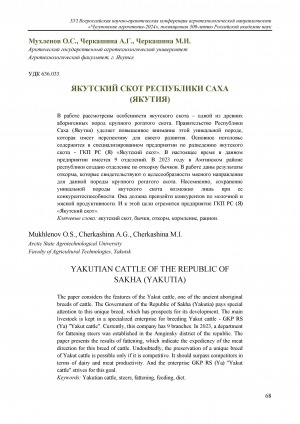
The paper considers the features of the Yakut cattle, one of the ancient aboriginal breeds of cattle. The Government of the Republic of Sakha (Yakutia) pays special attention to this unique breed, which has prospects for its development. The main livestock is kept in a specialized enterprise for breeding Yakut cattle - GKP RS (Ya) "Yakut cattle". Currently, this company has 9 branches. In 2023, a department for fattening steers was established in the Amginsky district of the republic. The paper presents the results of fattening, which indicate the expediency of the meat direction for this breed of cattle. Undoubtedly, the preservation of a unique breed of Yakut cattle is possible only if it is competitive. It should surpass competitors in terms of dairy and meat productivity. And the enterprise GKP RS (Ya) "Yakut cattle" strives for this goal.
Мухленов, О. С.
Якутский скот Республики Саха (Якутия) / Мухленов О. С., Черкашина А. Г., Черкашина М. И. ; ФГБОУ ВО "Арктический государственный агротехнологический университет", Агротехнологический факультет // Чугуновские агрочтения : сборник научных статей по материалам XVI Всероссийской научно-практической конференции агротехнологической направленности "Чугуновские агрочтения", посвященной 300-летию Российской академии наук, 3-4 апреля 2024 г., г. Якутск. - Якутск : Издательский дом СВФУ, 2024. - С. 68-71.
Год выпуска: 2022


Количество страниц: 10 с.
- Языкознание. Филология. Художественная литература > Языкознание и языки. Лингвистика > Якутский (саха),
- Языкознание. Филология. Художественная литература > Языкознание и языки. Лингвистика > Эвенкийский язык,
- НАУКА ЯКУТИИ > ЯЗЫКОЗНАНИЕ. ФИЛОЛОГИЯ. ЛИТЕРАТУРОВЕДЕНИЕ. ХУДОЖЕСТВЕННАЯ ЛИТЕРАТУРА > Языкознание и языки. Лингвистика,
- КНИГАКАН > Все народы > Эвены (тунгусо-маньчжурская группа языков) > Языкознание.
The paper presents a comparative analysis of word formation in Yakut and Evenki languages, with adjectives being the main focus. The structure of the adjective system in Turkic and Tungusic languages has not been fully understood yet. In these languages, adjectives can be derived from nouns, verbs, numerals, and adverbs. In modern Yakut language, new words are derived from stems of other word classes more actively than in Evenki language. Words formed this way are called converse words. They can be formed by derivation with an affix or zero derivation. Words conversed from roots consist of one morpheme and are not semantically connected to other words. In contrast, derivatives have several parts and are semantically connected to other words. The purpose of the study is to understand structure and semantics of conversion of adjectives as a way to form new words in Yakut and Evenki languages. It is the first attempt to systematize results of a complex analysis of conversion as a universal way of word formation illustrated by Yakut and Evenki adjectives. The results of the analysis show that despite universal character of conversion some features depend on the typological characteristic of a language. In Yakut and Evenki languages adjectives can be classified as various forms, from simple to complex. In contrast to nouns and verbs also present in vocabulary of both languages, adjectives have a specific morphological structure that differentiates them from other word classes.
Андреева, Т. Е. Конверсионные образования имен прилагательных в якутском и эвенкийском языках / Андреева Т. Е., Дьячковский Ф. Н. ; Институт гуманитарных исследований и проблем малочисленных народов Севера // Северо-Восточный гуманитарный вестник. - 2025. - N 1 (50). - С. 164-173. - DOI: 10.25693/SVGV.2025.50.1.012
DOI: 10.25693/SVGV.2025.50.1.012


Год выпуска: 2025