По Вашему запросу найдена 29461 запись
- Книга (8185)
- Газета (7893)
- Журнал (4002)
- Автореферат диссертации (467)
- Изоиздание (54)
- Аудиоиздание (609)
- Видеоиздание (464)
- Картографическое издание (30)
- Неопубликованный документ (468)
- Нотное издание (123)
- Фотография (831)
- Статья (2904)
- Библиографический указатель (528)
- Словарь (103)
- Календарь (7)
- Брошюра (170)
- Буклет (48)
- Электронное издание (1)
- Игра (2)
- 3D-модель (71)
- Грампластинка (92)
- Веб-архив (2409)
- Алтайский (1)
- Долганский (1)
- Английский (123)
- Эвенский (5)
- Французский (17)
- Немецкий (10)
- Казахский (5)
- Киргизский (1)
- Корейский (1)
- Старорусский (18)
- Осетинский (1)
- Польский (2)
- Русский (16422)
- Латинская графика (1124)
- Испанский (1)
- Тунгусский (1)
- Турецкий (24)
- Тувинский (4)
- Узбекский (1)
- Якутский (11654)
- Юкагирский (7)
- Не указан (11)
- Литературно-художественные издания (5499)
- Официальные издания (751)
- Научные издания (3996)
- Научно-популярные издания (2400)
- Информационные издания (13396)
- Справочные издания (260)
- Учебные издания (817)
- Производственно-практические издания (55)
- Массово-политические издания (1396)
- Изобразительное издание (880)

Издательство: Саха сиринээҕи кинигэ издательствота
Год выпуска: 1962
Номер (№): 4
Количество страниц: 122 с.
- Периодические издания Якутии (конец XIX – XXI вв.) > Журналы > Чолбон (Кыhыл ыллык - Уус-уран литиэратуура - Хотугу сулус) > Хотугу сулус > 1962,
- Газеты на якутском языке > Хотугу сулус > 1962,
- Общий отдел,
- КНИГАКАН > Все народы > Эвенки (тунгусо-маньчжурская группа языков) > Художественная литература.
- 1. Хотугу сулус: [сахалыы тылынан уус-уран литературнай. уонна общественно-политическай сурунаал], 1962, №1
- 2. Хотугу сулус: [сахалыы тылынан уус-уран литературнай. уонна общественно-политическай сурунаал], 1962, №2
- 3. Хотугу сулус: [сахалыы тылынан уус-уран литературнай. уонна общественно-политическай сурунаал], 1962, №3
- 4. Хотугу сулус: [сахалыы тылынан уус-уран литературнай. уонна общественно-политическай сурунаал], 1962, №5
- 5. Хотугу сулус: [сахалыы тылынан уус-уран литературнай. уонна общественно-политическай сурунаал], 1962, №6

Издательство: Наука, Ленинградское отделение
Год выпуска: 1969
Количество страниц: 448 с.
- Сылгы - саха төрүт баайа / Якутская лошадь,
- Улусы (районы) Республики Саха (Якутия) > Верхоянский улус > Об улусе,
- Традиционные верования саха > Верования якутов,
- Национальная культура, обряды, праздники коренных малочисленных народов Севера > Традиционные обряды, праздники, искусство коренных малочисленных народов Якутии > Эвены,
- Якутский круговой танец осуохай > Сведения об осуохае в трудах исследователей XVIII—XIX вв.,
- Общественные науки. Образование,
- iYakutia > Загадки Якутии > Город призрак - Зашиверск,
- iYakutia > Terra Yakutia > Улусы, города, населенные пункты,
- КНИГАКАН > Все народы > Эвены (тунгусо-маньчжурская группа языков) > Этнография. Фольклор.

Издательство: Якутское книжное издательство
Год выпуска: 1955
Серия, номер выпуска: вып.1 (4)
Количество страниц: 180 с.

Издательство: Советская Россия
Год выпуска: 1970
Количество страниц: 164 с.
- Попов Леонид Андреевич > Произведения,
- Якутско-русские и русско-якутские переводы произведений писателей > Переводы произведений якутских писателей на русский язык > Народные писатели Якутии > Попов Леонид Андреевич,
- Языкознание. Филология. Художественная литература,
- ШКОЛА > Предметные подборки > Художественная литература > Якутская литература.

Количество страниц: 14 с.
- 1. Игонина Светлана Викторовна. Медицинская тема в русской литературе = Medical theme in Russian literature
- 2. Ноева Елена Евгеньевна, Яндубаева Лидия Сергеевна . Исследование финансового потенциала муниципального образования Арктической зоны (на примере Жиганского района РС (Я) = A study of the financial potential of the municipality of the Arctic zone: the case of Zhigansky district of the Republic of Sakha (Yakutia))
- 3. Яковлева Евдокия Павловна. Роль жизнестойкости в адаптации молодёжи к новым реалиям = The role of resilience in youth adaptation to new realities
- 4. Дишкант Елена Валерьевна, Соловьева Мария Сергеевна. К 80-летию доктора педагогических наук, профессора Светланы Максимовны Петровой = On the 80th anniversary of Doctor of Pedagogical Sciences, Professor Svetlana Maksimovna Petrova
- 5. Неустроева Анна Николаевна. Профессор Августина Васильевна Иванова: учёный, педагог, созидатель = Professor Augustina Ivanova: scholar, teacher, creator
- 6. Калаврий Татьяна Юрьевна, Федоров Юрий Юрьевич. Адаптация методических рекомендаций к потенциалу опорного населенного пункта на примере городского поселения Алдан в Республике Саха (Якутия) = Adaptation of methodological recommendations to the potential of a key settlement: the case of the urban settlement of Aldan, Yakutia
- 7. Сибилева Елена Валерьевна, Ефимова Арина Александровна. Техногенные катастрофы и вызовы природопользованию в регионе Республика Саха (Якутия) = Man-made disasters and challenges to environmental management in the Sakha Republic (Yakutia)
- 8. Винокурова Марфа Александровна. Развитие событийного туризма на территории Республики Саха (Якутия) = Development of event tourism in the Republic of Sakha (Yakutia)
- 9. Баттахов Петр Петрович. Особенности правового регулирования территорий Дальневосточного федерального округа и Арктической зоны с преференциальным режимом = Peculiarities of legal regulation of the territories of the Far Eastern Federal District and the Arctic zone with preferential treatment
- 10. Васягина Наталия Николаевна, Градинар Екатерина Васильевна. Психологические особенности восприятия детско-родительских отношений в семьях, воспитывающих младших подростков = Psychological features of perception of parent-child relationships in families raising young adolescents
- 11. Болотаева Ольга Сергеевна. Некоторые аспекты правового регулирования цифровых платформ в Российской Федерации = Some aspects of the legal regulation of digital platforms in the Russian Federation
- 12. Ефимова Мария Прометеевна. Криминогенные детерминанты насильственного поведения в сфере семейных отношений = Criminogenic determinants of violent behavior in the field of family relations
- 13. Корякина Зинаида Ивановна. К вопросу об обязательном участии защитника в уголовном судопроизводстве = On the issue of mandatory participation of a defense attorney in criminal proceedings
- 14. Павлова Арзулана Акрамовна. К вопросу о понятии "цифровая преступность" = On the concept of "digital crime"
- 15. Парфенова Ольга Афанасьевна, Николаев Алексей Ильич. Леналенд: анализ геополитического статуса Якутии в XXI веке = Lenaland: analysis of Yakutia’s geopolitical status in the 21st century
- 16. Горохова Анна Ивановна, Сидоров Ян Николаевич. История урбанонимов г. Якутска как индикатор политики памяти = History of urbanonyms the city of Yakutsk as an indicator of memory policies
- 17. Шишкина Светлана Кирилловна, Новиков Виталий Николаевич. История международных спортивных игр "Дети Азии" = The history of international sports games for "Asian Children"
- 18. Корякина Анжелина Анатольевна. Межкультурный мировоззренческий подход как стратегия воспитания личности = Intercultural worldview approach as a strategy for personality development
- 19. Якса Наталья Владимировна, Платонова Раиса Ивановна. Нравственная культура как основа педагогического мастерства учителя = Moral culture as the foundation of teacher pedagogical excellence
- 20. Давлетбаков Арслан Асхатович, Бабичева Рита Исмагиловна, Семенова Мария Николаевна, Корзникова Елена Александровна. Анализ влияния ближнего порядка на механизмы деформации при сдвиге высокоэнтропийных сплавов TiNbZrV и TiNbZrhf = Analysis of short-range ordering effect on shear deformation mechanisms of high-entropy alloys TiNbZrV and TiNbZrhf
- 21. Хохолова Ирена Семеновна. Особенности цветообозначений в эпосе и способы их перевода с якутского на французский язык = Features of color meanings in the epic and their translation strategies from Yakut into French
- 22. Федоров Артур Григорьевич, Жондорова Любовь Леонидовна, Федорова Любовь Константиновна. Методы оценки и анализа разрешающей способности цифровых голографических микроскопов = Method for estimating and analyzing the resolution of digital holographic microscopy
- 23. Самсонова Лариса Николаевна. Лексико-семантические и структурно-грамматические характеристики эргонимов г. Якутска = Lexical-semantic and structural-grammatical characteristics of ergonyms in Yakutsk
- 24. Слепцова Галина Николаевна. Наименования мер длины – компоненты фразеологизмов, пословиц и поговорок в якутском, русском и английском языках = Names of length measures – components of phraseological units, proverbs and sayings in Yakut, Russian and English
- 25. Яковлева Любовь Анатольевна, Евтухова Алина Максимовна. Лингвокультурные особенности русских и эвенкийских гидронимов Южной Якутии = Linguocultural characteristics of Russian and Evenki hydronyms in South Yakutia
- 26. Сивцева Наталия Александровна. Сообщение о Всероссийской научно-практической конференции "Актуальные проблемы лексической и грамматической семантики", посвященной 75-летию со дня рождения доктора филологических наук Николая Николаевича Ефремова = A review of the All-Russian scientific and practical conference “Current problems of lexical and grammatical semantics” dedicated to the 75th anniversary of the birth of Doctor of Philological Sciences Nikolay Nikolaevich Efremov
- 27. Сатанар Марианна Тимофеевна. Эпосы олонхо и нимкан в контексте знаковых систем = The epics of Olonkho and Nimkan in the context of sign systems
- 28. Кузьмина Раиса Петровна. Символические образы насекомых в эвенском фольклоре = Symbolic images of insects in even folklore
- 29. Жиркова Евгения Егоровна. Образная лексика звукомимического происхождения, характеризующая выражение лица персонажей олонхо = Figurative vocabulary of sound-mimic origin characterizing facial expressions of olonkho characters
- 30. Саввинов Василий Михайлович. Оценка вовлеченности молодежи в образовательные инициативы = Evaluation of youth involvement in educational initiatives
- 31. Борисова Валерия Сергеевна. Общетюркская аналитическая конструкция в абыйском говоре якутского языка (на материале полевых исследований) = The Turkic analytical construction in the Abyi dialect of the Yakut language (based on field research)
- 32. Давыдова Лиана Николаевна, Иванова Саргылана Владимировна. Перевод терминологии индустрии красоты на якутский язык. Кэрэ эйгэтин тиэрминнэрин сахалыы тылбааhа = Translation of beauty industry terminology into the Yakut language
- 33. Ефимова Людмила Степановна. Термины национальной гастрономической культуры якутов в записях Я. И. Линденау (I половина XVIII в.) = Terms of the national gastronomic culture of the Yakuts in the records of Jacob Lindenau (first half of the 18th century)
- 34. Ефремова Надежда Анатольевна, Семенова Светлана Владимировна. Лексико-семантический анализ имен собственных якутского эпоса олонхо = Lexical and semantic analysis of proper names in the Yakut epic olonkho
- 35. Яковлева Любовь Анатольевна, Кутузова Виктория Максимовна. Семантика топонимического пространства Южной Якутии как инструмент патриотического воспитания = Semantics of the toponymic space of Southern Yakutia as a tool for patriotic education
- 36. Пшенникова Галина Максимовна, Николаева Татьяна Яковлевна, Адамова Рената Николаевна. Распространенность и терапия эпилепсии в Якутии = Prevalence and treatment of epilepsy in Yakutia
- 37. Пинелис Иосиф Семенович, Петрова Александра Моисеевна, Малежик Маргарита Сергеевна, Шнитова Ирина Валерьевна, Ушницкий Иннокентий Дмитриевич. Роль дисбиоза полости рта в патологии органов дыхания и системных заболеваниях = The role of oral dysbiosis in respiratory pathology and systemic diseases (literature review)
- 38. Вестник Северо-Восточного федерального университета им. М. К. Аммосова, 2025, №3 (101)
The relevance of this study is due to the need for a comprehensive understanding of the phenomenon of Sergey Zverev – Kyyl Uola (the Animal’s Son). His work, being at the junction of authentic folklore performance and Soviet cultural modernization, is a unique model of artistic syncretism. The study of his heritage allows us to identify the mechanisms of adaptation of ethnic traditions in the context of ideological challenges of modern times, which is an important task of modern folklore studies and cultural studies. The problem of the study lies in the existing dissonance between the scale of the personality of Sergey Zverev – Kyyl Uola and the lack of its holistic scientific understanding. Despite the extensive factual material, his work is often analyzed fragmentarily: either as a folklore heritage, or as choreographic innovation, or in the context of biographical data. The purpose of the study is to identify and characterize the unique syncretic nature of the work of Sergey Zverev – Kyyl Uola, manifested in the organic unity of storytelling, song, choreography and acting talent, and to determine his role in the development of the traditional culture of the Sakha (Yakut) people in the 20th century. To achieve this goal, the following tasks were set: to identify the origins of the formation of the syncretic talent of Zverev through the prism of the continuity of family tradition and the vast geography of his creative wanderings; to determine the place and role of Zverev in the storytelling tradition of the Sakha people through a comparison of his performing style with the work of other olonkho-tellers of his generation; to conduct a genre and typological analysis of the singer’s folklore heritage with an emphasis on the specifics of his improvisational style and innovative rethinking of traditional forms in the context of the Soviet era; to generalize the organizational practices of Zverev in managing amateur performances, which led to the unprecedented recognition of his ensemble at the all-Union level. The main research methods were: the historical and methodological method allowed us to systematize the stages of Zverev’s creative path and identify stable, typological features of his art in the context of the development of the Yakut culture of the 20th century; the comparative typological method was used to compare the performing style of Zverev with the work of other olonkho-tellers of his generation, as well as to analyze the variability of his improvisations; the biographical method is key to reconstructing the storyteller’s life path, analyzing the influence of the family environment, teachers and “wandering life” on the formation of his unique talent; the source study method is the basis for working with a corpus of texts: publications in periodicals, memoirs of contemporaries and field diaries of researchers. The conducted study of the work of Sergey Zverev – Kyyl Uola allows us to draw a conclusion confirming his unique role as a cultural translator who synthesized the archaic tradition of the Sakha people with the challenges and demands of the Soviet era. It has been established that the formation of his syncretic talent was the result of the continuity of a family of hereditary toyuk-tellers, from Yrjan Yakov and the unique experience of a “wandering life”, which became a living school for honing improvisational skills and expanding the repertoire. Genre and typological analysis of his folklore heritage. Genre and typological analysis of his folklore heritage revealed not only a profound mastery of traditional poetics, but also an innovative approach to improvisation, which allowed him to create relevant texts glorifying both the nature of Yakutia and the achievements of the Soviet people. His contribution to olonkho, although not realized in the form of full text recordings, turned out to be significant in the stage embodiment of epic images, which became a practical fulfillment of his teacher’s behest and influenced subsequent generations of performers. The activities of Zverev as an organizer of amateur performances had an unprecedented resonance. Under his leadership, the folk ensemble from Suntarsky District raised Yakut dance to a professional level, making productions (“Patterns”, “Eagle Dance”) the hallmark of Yakut culture at all-Union festivals. His advisory role in the creation of the first Yakut opera and ballet shows his deep understanding of the mechanisms of translating folklore aesthetics into the language of professional art. Prospects for further research are seen in the textual analysis of folklore texts, as well as understanding him as an organizer of amateur art. Studying the legacy of Sergey Zverev, who stood at the origins of professional art, is a priority for future researchers.
Илларионов, В. В. Творческий феномен С. А. Зверева – Кыыл Уола и его значение для сохранения якутского фольклорного наследия / В. В. Илларионов, Т. В. Илларионова ; Северо-Восточный федеральный университет им. М. К. Аммосова, Арктический государственный институт культуры и искусств // Вестник Северо-Восточного федерального университета им. М. К. Аммосова. Серия "Эпосоведение". - 2025. - N 3 (39). - С. 50-63. - DOI: 10.25587/2782-4861-2025-3-50-63
DOI: 10.25587/2782-4861-2025-3-50-63

Количество страниц: 18 с.
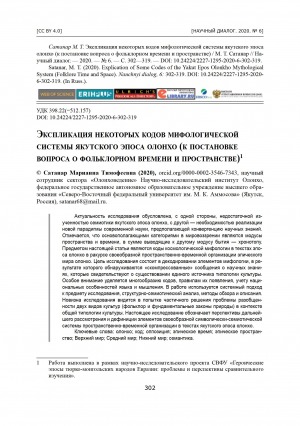
The relevance of the study is due, on the one hand, to the insufficient knowledge of the semiotics of the Yakut epos olonkho, and on the other, the need to implement a new paradigm of modern science, which involves the convergence of scientific knowledge. It is noted that the fundamental categories in the worldview are the modes of space and time, which in total lead to another mode of being — a chronotope. The subject of this article is the codes of cosmological mythology in the texts of the epic olonkho from the perspective of a peculiar spatio-temporal organization of the epic world of olonkho. The purpose of the study is to decode the elements of mythology, as a result of which "compressed" messages about scientific knowledge that indicate the existence of a single source of typology of culture are found. Particular attention is paid to the variety of codes, the rules for their emergence, taking into account the national characteristics of language and thinking. A systematic approach to the subject of study, structural-semiotic analysis, methods of review and description are used in the study. The novelty of the study is in an attempt to partially solve the problem of the disunity of two types of cultures (folklore and fundamental laws of nature) in the context of a general typology of culture. This study indicates the prospects for further consideration and definition of the elements of a peculiar symbolic-semiotic system of space-time organization in the texts of the Yakut epos olonkho
Сатанар М. Т. Экспликация некоторых кодов мифологической системы якутского эпоса олонхо (к постановке вопроса о фольклорном времени и пространстве) // Научный диалог. 2020. N 6. С. 302-319. DOI: 10.24224/2227-1295-2020-6-302-319
DOI: 10.24224/2227-1295-2020-6-302-319
Год выпуска: 2025

Количество страниц: 10 с.
- Саха тыла/Якутский язык > Научные труды по якутскому языку > Лексикология,
- Языки народов Якутии > Якутский язык > Научные труды по якутскому языку > Лексикология,
- Языкознание. Филология. Художественная литература > Языкознание и языки. Лингвистика > Якутский (саха),
- НАУКА ЯКУТИИ > ЯЗЫКОЗНАНИЕ. ФИЛОЛОГИЯ. ЛИТЕРАТУРОВЕДЕНИЕ. ХУДОЖЕСТВЕННАЯ ЛИТЕРАТУРА > Языкознание и языки. Лингвистика.
Васильева, Н. Н. Сравнительный анализ семантической структуры и словообразовательных гнезд якутских полисемантов төбө и бас ʻголоваʼ / Н. Н. Васильева // Северо-Восточный гуманитарный вестник. — 2022. — N 1 (38). — C. 79-88. — DOI: 10.25693/SVGV.2022.38.1.007.
DOI: 10.25693/SVGV.2022.38.1.007
