По Вашему запросу найдена 29461 запись
- Книга (8185)
- Газета (7893)
- Журнал (4002)
- Автореферат диссертации (467)
- Изоиздание (54)
- Аудиоиздание (609)
- Видеоиздание (464)
- Картографическое издание (30)
- Неопубликованный документ (468)
- Нотное издание (123)
- Фотография (831)
- Статья (2904)
- Библиографический указатель (528)
- Словарь (103)
- Календарь (7)
- Брошюра (170)
- Буклет (48)
- Электронное издание (1)
- Игра (2)
- 3D-модель (71)
- Грампластинка (92)
- Веб-архив (2409)
- Алтайский (1)
- Долганский (1)
- Английский (123)
- Эвенский (5)
- Французский (17)
- Немецкий (10)
- Казахский (5)
- Киргизский (1)
- Корейский (1)
- Старорусский (18)
- Осетинский (1)
- Польский (2)
- Русский (16422)
- Латинская графика (1124)
- Испанский (1)
- Тунгусский (1)
- Турецкий (24)
- Тувинский (4)
- Узбекский (1)
- Якутский (11654)
- Юкагирский (7)
- Не указан (11)
- Литературно-художественные издания (5499)
- Официальные издания (751)
- Научные издания (3996)
- Научно-популярные издания (2400)
- Информационные издания (13396)
- Справочные издания (260)
- Учебные издания (817)
- Производственно-практические издания (55)
- Массово-политические издания (1396)
- Изобразительное издание (880)
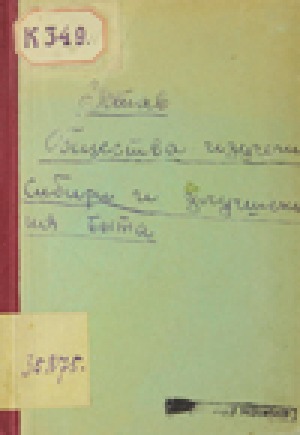
Издательство: Типография Якутского Областного Управления
Год выпуска: 1908
Количество страниц: 20 с.
Год выпуска: 2022
Издательство: Бичик
Год выпуска: 2017
Серия, номер выпуска: Вып. 3
Количество страниц: 344 с.
- Күлүмнүүр (Кюлюмнюр) - Никифоров Василий Васильевич > Литература о жизни и деятельности В.В. Никифорова,
- Изобразительное искусство Якутии: живопись, графика, скульптура > Художники Якутии > А - Н,
- Изобразительное искусство Якутии: живопись, графика, скульптура > Художники Якутии > О - Я,
- Жирков Александр Николаевич > Составительская и редакторская деятельность,
- Театральное искусство > Саха академический театр имени П. А. Ойунского > Саха театр в наши дни,
- Искусство. Фотография. Музыка. Игры. Спорт.
Год выпуска: 2021

Количество страниц: 6 с.
- Саха тыла/Якутский язык > Научные труды по якутскому языку > Грамматика (морфология, синтаксис),
- Языки народов Якутии > Якутский язык > Научные труды по якутскому языку > Грамматика (морфология, синтаксис),
- Языкознание. Филология. Художественная литература > Языкознание и языки. Лингвистика > Якутский (саха),
- Языкознание. Филология. Художественная литература > Языкознание и языки. Лингвистика > Русский язык,
- Языкознание. Филология. Художественная литература > Языкознание и языки. Лингвистика > Английский язык,
- НАУКА ЯКУТИИ > ЯЗЫКОЗНАНИЕ. ФИЛОЛОГИЯ. ЛИТЕРАТУРОВЕДЕНИЕ. ХУДОЖЕСТВЕННАЯ ЛИТЕРАТУРА > Языкознание и языки. Лингвистика.
Борисова, М. В. Ассоциативное поле макросинего цветоспектра в английской, русской, якутской картинах мира / М. В. Борисова, В. А. Петрова ; Северо-Восточный федеральный университет им. М. К. Аммосова // В мире науки и искусства: вопросы филологии, искусствоведения и культурологии. - 2014. - N 43. - С. 56-61.

Количество страниц: 10 с.
The relevance of the topic is due to the need for a systematic study of the character series of the Yakut epic olonkho, including previously unstudied mythological images. The article for the first time examines the images of the hero's heavenly patrons in five olonkho texts about the Nyurgun heroes, representing various epic traditions of Central Yakutia. The purpose of the article is to study the images of the hero's heavenly patrons in the context of the figurative system of the olonkho about the Nyurguns, to clarify their role and functions in the plot structure. To achieve the goal, the following tasks were set: compiling a systematization of heavenly patrons and identifying their functional features. The study was conducted using comparative-typological and comparative-contrastive methods. Using a systematic approach, an attempt was made to classify the images of heavenly patrons by their characteristics and functioning in the plot structure. As a result of the study, we come to the conclusion that heavenly patrons act as intermediaries between the deities and the main characters - the Nyurgun heroes. They can be classified as heavenly messengers, heavenly warriors, heavenly udagan women and the heavenly patron of men. They are of great importance in the storyline, their functions and actions develop along with the events and episodes that happen to the main character. The main function is to convey the orders of the deities, to notify about disasters, to warn about dangerous situations, to provide assistance in battle, and to indicate betrothed. Based on the fact that Nyurgun initially developed the type of a warrior - the defender of the tribe, the celestials in every possible way protect and direct him in the right direction. The presence of heavenly patrons in the plot structure is one of the features of the olonkho texts about Nyurguns, since these warriors have a heavenly-divine origin and are settled in the Middle World with the mission to protect the tribe, due to which the participation and patronage of mythological characters are inevitable. It is necessary to state that over time their appearance and functional features were subject to transformation processes, even a complete disappearance from the plot structure is noted. The prospect of this study is assumed in the systematic study of mythological characters in epic texts.
Оросина, Н. А. Образы небесных покровителей героя в якутских олонхо о богатырях Нюргунах / Н. А. Оросина ; Институт гуманитарных исследований и проблем малочисленных народов Севера // Вестник Северо-Восточного федерального университета им. М. К. Аммосова. Серия: Эпосоведение. - 2024, N 4 (36). - С. 95-104. - DOI: 10.25587/2782-4861-2024-4-95-104
DOI: 10.25587/2782-4861-2024-4-95-104


Ответственность: Радченко Наталья Николаевна (Научный руководитель)
Количество страниц: 5 с.
- Общественные науки. Образование > Народное образование. Воспитание. Обучение. Организация досуга > Профессиональное и среднее специальное образование,
- НАУКА ЯКУТИИ > ОБЩЕСТВЕННЫЕ НАУКИ > Народное образование. Воспитание. Обучение. Организация досуга > Профессиональное и среднее специальное образование.
The article examines the history of the creation of the Yakut Republican Department of Vocational Education, the history of the development of vocational education in the mid-1960s, the prerequisites for the creation of a new state body and its first steps.
Иванов, Н. Н. История создания якутского республиканского управления профессионально-технического образования / Н. Н. Иванов ; научный руководитель Н. Н. Радченко ; Северо-Восточный федеральный университет им. М. К. Аммосова, Исторический факультет // Аргуновские чтения - 2024. - Якутск : ИЦ НБ РС (Я). - (Культура Арктики ; вып. 15). - С. 364-368.
Количество страниц: 18 с.
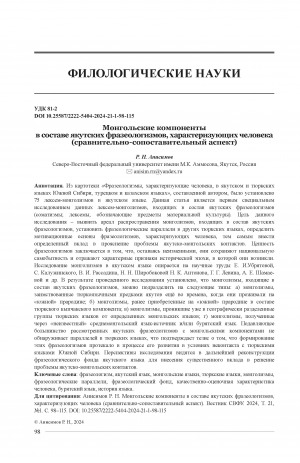
From the card index “Phraseologisms characterising a human being in Yakut and Turkic languages of South Siberia, Turkish and Kazakh” compiled by the author, 75 lexeme-mongolisms in the Yakut language were identified. This article is the first special study of these lexemes-mongolisms, which are part of Yakut phraseologisms (somatisms; lexemes denoting objects of material culture). The aim of this study is to identify the area of distribution of Mongolisms included in Yakut phraseological phrases, to establish phraseological parallels in other Turkic languages, to determine the motivational bases of phraseological phrases characterising human beings. Thus, to make a certain contribution to the clarification of the problem of Yakut-Mongolian contacts. The value of phraseologisms lies in the fact that remaining unchanged, they preserve national identity and reflect the characteristic features of the historical epoch in which they originated. The study of Mongolisms in the Yakut language is based on the scientific works of E.I. Ubryatova, S. Kaluzhinsky, V.I. Rassadin, N.N. Shirobokova, N.K. Antonov, G.G. Levin, A.E. Shamaeva and others. As a result of the study, it was established that: Mongolisms included in Yakut phraseologisms can be subdivided into the following types - a) Mongolisms borrowed by the Turkic-speaking ancestors of the Yakuts back in the times when they lived in the “southern” ancestral homeland; b) Mongolisms previously acquired in the “southern” ancestral homeland as part of the Turkic Kypchak component; c) Mongolisms that penetrated already in geographically separated groups of Turkic languages from certain Mongolian languages; d) Mongolisms acquired through an “unknown” Middle Mongolian source language and/or Buryat language. The overwhelming majority of the considered Yakut phraseologisms with Mongolian components do not find parallels in the Turkic languages, which confirms the thesis that the formation of these phraseologisms took place in the process of their development under conditions of non-contact with the Turkic languages of South Siberia. The prospects of the study are seen in further reconstruction of the phraseological fund of the Yakut language in order to make a significant contribution to the solution of the problem of Yakut-Mongolian contacts.
Анисимов, Р. Н. Монгольские компоненты в составе якутских фразеологизмов, характеризующих человека (сравнительно-сопоставительный аспект) / Р. Н. Анисимов ; Северо-Восточный федеральный университет им. М. К. Аммосова // Вестник Северо-Восточного федерального университета им. М. К. Аммосова. - 2024. - Т. 21, N 1 (95). - С. 98-115. - DOI: 10.25587/2222-5404-2024-21-1-98-115
DOI: 10.25587/2222-5404-2024-21-1-98-115

Год выпуска: 2023