По Вашему запросу найдено 2314 записей
- Книга (6540)
- Газета (6293)
- Журнал (3209)
- Автореферат диссертации (360)
- Изоиздание (45)
- Аудиоиздание (471)
- Видеоиздание (374)
- Картографическое издание (24)
- Неопубликованный документ (360)
- Нотное издание (105)
- Фотография (666)
- Статья (2314)
- Библиографический указатель (427)
- Словарь (86)
- Календарь (6)
- Брошюра (133)
- Буклет (40)
- Игра (2)
- 3D-модель (51)
- Грампластинка (78)
- Веб-архив (1929)
- Не указан (9)
- Литературно-художественные издания (4426)
- Официальные издания (585)
- Научные издания (3145)
- Научно-популярные издания (1937)
- Информационные издания (10683)
- Справочные издания (207)
- Учебные издания (654)
- Производственно-практические издания (40)
- Массово-политические издания (1124)
- Изобразительное издание (703)
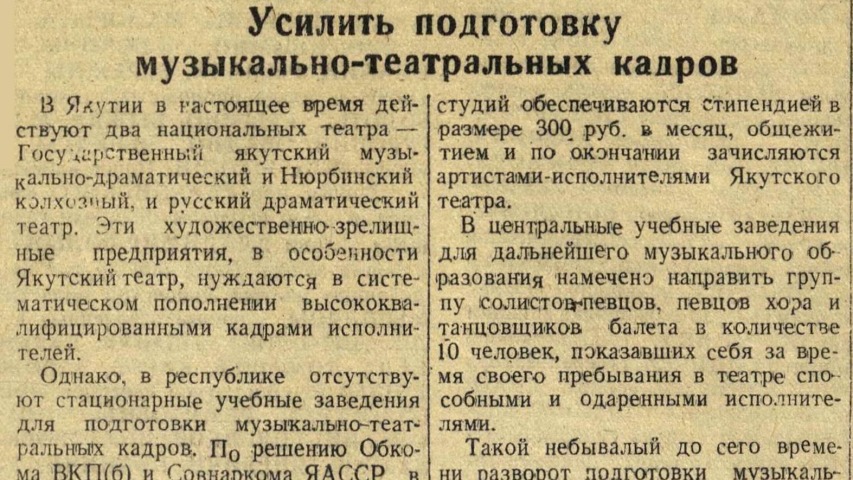

Источник: Социалистическая Якутия. - 1942. - N 37 (5546), 12 февраля. - С. 3.
Количество страниц: 1 с.

Количество страниц: 12 с.
- Языкознание. Филология. Художественная литература > Языкознание и языки. Лингвистика > Якутский (саха),
- Языкознание. Филология. Художественная литература > Языкознание и языки. Лингвистика > Другие языки,
- НАУКА ЯКУТИИ > ЯЗЫКОЗНАНИЕ. ФИЛОЛОГИЯ. ЛИТЕРАТУРОВЕДЕНИЕ. ХУДОЖЕСТВЕННАЯ ЛИТЕРАТУРА > Языкознание и языки. Лингвистика.
This paper examines the “metallic” epithets in the Yakut Olonkho and Altai kai chӧrchӧk in a comparative aspect in order to reveal the parallels and specific features of the functioning of these epithets in the epic of peoples related in the historical past. The following methods were used: contextual analysis, analysis of dictionary definitions, quantitative methods, and the inductive method, which allows generalizing the results of applying all the methods. The comparative study revealed many similarities. In both epics, metal epithets in the structure are radical, derived from the lexeme denoting the name of the metal. In a denotative meaning, they characterize objects by the material from which they are made. The choice of specific metallic epithets as contextual synonyms in the structure of the epic formula is due to the phenomenon of vowel harmony inherent in most Turkic languages. The genetic community of the Yakut and Altai peoples probably explains the similar features of the metallic epithets. Also, the differences have been established: according to the frequency of using the epithets formed from the nominations of precious metals, the ancient Yakuts preferred silver, and the Altai people preferred gold. The differences and peculiarities of functioning of “metal” epithets in the Yakut and Altai epic texts can be explained by the stage difference in the development of the epic texts compared.
Корякина, Р. В. Особенности функционирования одного эпитета в якутском и алтайском эпических текстах / Р. В. Корякина ; Северо-Восточный федеральный университет им. М. К. Аммосова // Сибирский филологический журнал. - 2022. - N 1. - С. 36-47. - DOI: 10.17223/18137083/78/3
DOI: 10.17223/18137083/78/3

Источник: Вестник Северо-Восточного федерального университета им. М. К. Аммосова : научный журнал. - 2021, N 3 (83).
Количество страниц: 13 с.
Ноева, С. Е. Особенности поэтики и структуры городского текста в якутском геокультурном ландшафте / С. Е. Ноева // Вестник Северо-Восточного федерального университета им. М. К. Аммосова. – 2021. – N 3 (83). – С. 93-105. – DOI: 10.25587/SVFU.2021.83.3.007
DOI: 10.25587/SVFU.2021.83.3.007
Количество страниц: 6 с.
- Языкознание. Филология. Художественная литература > Языкознание и языки. Лингвистика > Эвенкийский язык,
- НАУКА ЯКУТИИ > ЯЗЫКОЗНАНИЕ. ФИЛОЛОГИЯ. ЛИТЕРАТУРОВЕДЕНИЕ. ХУДОЖЕСТВЕННАЯ ЛИТЕРАТУРА > Языкознание и языки. Лингвистика,
- КНИГАКАН > Все народы > Эвенки (тунгусо-маньчжурская группа языков) > Языкознание.
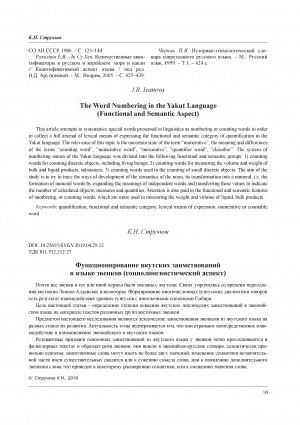
Стручков К. Н. Функционирование якутских заимствований в языке эвенков (социолингвистический аспект) / К. Н. Стручков // Северо-Восточный гуманитарный вестник. - 2019. - N 4 (29). - С. 95-100
DOI: 10.25693/SVGV.2019.04.29.12
Количество страниц: 4 с.
- Общественные науки. Образование > Народное образование. Воспитание. Обучение. Организация досуга > Организация воспитания и образования. Школоведение,
- Общественные науки. Образование > Народное образование. Воспитание. Обучение. Организация досуга > Общеобразовательная школа. Дошкольные учреждения,
- НАУКА ЯКУТИИ > ОБЩЕСТВЕННЫЕ НАУКИ > Народное образование. Воспитание. Обучение. Организация досуга > Организация воспитания и образования. Школоведение,
- НАУКА ЯКУТИИ > ОБЩЕСТВЕННЫЕ НАУКИ > Народное образование. Воспитание. Обучение. Организация досуга > Общеобразовательная школа. Дошкольные учреждения,
- Билии / Школа > Учусь > Образовательный навигатор > Арт-пространство и Спорт > Профориентация и выбор пути,
- Билии / Школа > Учусь > Педагогическая мастерская > Учительская: инструменты и вдохновение > Отдельные направления воспитания школьников > Профориентация,
- Билии / Школа > Учусь > Педагогическая мастерская > Учительская: инструменты и вдохновение > Организация работы общеобразовательного учреждения > Методы, формы и средства обучения,
- Билии / Школа > Учусь > Педагогическая мастерская > Учительская: инструменты и вдохновение > Копилка идей: из опыта работы.
- 1. Прудецкий Роман Константинович. Проектная деятельность по направлению виртуальной и дополненной реальности в смене лагеря "Арктика и Космос" = Project-based activities in virtual and augmented reality during the Arctic and Space camp
- 2. Толмачева Татьяна Викторовна, Мачахова Галина Иннокентьевна. Технологический профиль школы: стратегия подготовки конкурентоспособных выпускников = The technological profile of a school as a strategy for training competitive graduates
- 3. Семенов Алексей Климентьевич. Потенциал интеграции профильных классов с направленностями дополнительных общеобразовательных программ (на примере подготовки обучающихся по профилю креативных индустрий) = The potential of integrating specialized classes with additional general education programs (a case study of training students for creative industries)
- 4. Матвеева Саргылана Георгиевна, Корякина Надежда Афанасьевна. Профориентационная карта формирования психолого-педагогических групп в школе = A career guidance map of psychological and pedagogical groups in a school
- 5. Афонский Георгий Афанасьевич, Пинигина Антонина Алексеевна, Самсонова Полина Ильинична. Учитель со школьной скамьи: об опыте работы по организации деятельности педагогического класса в школе = Teacher from the school bench: experience in organizing a pedagogical class at school N 23 named after V. I. Malyshkin
- 6. Кузнецова Инна Олеговна, Квашина Светлана Юрьевна. Школа у взлётно-посадочной полосы: авиационный уклон образования для новых поколений = A school near the runway: aviation-oriente deducation for newg enerations
- 7. Слепцова Ирена Дидимовна. Предпрофессиональная подготовка и профориентация детей с умственной отсталостью через работу по проекту "Ориентир - пропуск в профессиональный мир" = Preprofessional training and career guidance of children with intellectual disabilities through the orientir as access to the professional world project
- 8. Бубякина Алина Егоровна, Саргыдаева Саргылана Анатольевна. Медицинский класс школы N 31: ступени к профессии врача = The medical class at school Т 31: stages toward the medical profession
- 9. Андреева Наталья Владимировна. Психолого-педагогические классы: современный трамплин в профессию = Psychological and pedagogical classes as a modem pathway to the profession
- 10. Корякина Евдокия Егоровна. От пропедевтики к профилю: опыт построения непрерывного технологического образования в Физико-техническом лицее им. В. П. Ларионова = From propaedeutics to specialization: experience in building continuous technological education at the Physics and technology lyceum named after V. P. Larionov
- 11. Колодезников Альберт Леонидович. Стратегическое социальное партнерство открывает двери в мир профессий = Strategic social partnership as a pathway for training future environmental specialists
- 12. Однокопылова Евгения Петровна, Шарин Георгий Георгиевич. Особенности организации профильного геологического образования в гимназии = Features of organizing specialized geological education in a gymnasium
- 13. Иванова Саргылана Никитична. Инновационные технологические процессы в действии: опыт центра технического творчества = Innovative technological processes in action: experience of the center for technical creativity
- 14. Стручкова Саргылана Тарасовна. Этнокультурный компонент в призме профессионального самоопределения детей в учреждении дополнительного образования = The ethnocultural component in the context of professional self-determination of children in an additional education institution
- 15. Петрова Наталья Николаевна, Хазагарова Мария Борисовна. Профориентация 5.0.: Проект "Выбор.Проф.Якутск" = Careerguidance 5.0: The Choice.Prof.YakutsK. Project
- 16. Скрябина Александра Николаевна, Хазагарова Мария Борисовна. Через творчество - к компетенциям "Выбор.Проф.Якутск" = From creativity to competence development: The choice. Prof.Yakutsk. Project
- 17. Захарова Анастасия Михайловна. Профессиональное самоопределение школьника посредством профессиональных проб = Student professional self determination through professional trials
- 18. Матвеев Мирослав Васильевич. Реализация инженерных проектов в условиях летнего лагеря = Implementation of engineering projects in a summer camp environment
- 19. Киуру Яна Евгеньевна. Реализация образовательной программы медицинского класса в рамках модели сотрудничества "Школа - среднее профессиональное образование" = Implementation of a medical class educational program within the school-secondary vocational education cooperation model
- 20. Колесова Нарыйаана Анатольевна. Профессиональные конкурсы школьников в системе профориентационной работы образовательного учреждения = Student professional competitions in the system of career guidance work of an educational institution
- 21. Петрова Мария Петровна. Профильное обучение: ответы на запросы развития территории = Profile-based education: responses to territory development requests
- 22. Портнягина Яна Викторовна. Проектная деятельность обучающихся в условиях агрошколы: интеграция общего и агротехнологического образования = Project-based learning in the context of an agricultural school: integration of general and agrotechnological education
- 23. Габышева Феодосия Васильевна. Инновационные подходы к профильному образованию в школьной системе Якутии: опыт и перспективы = Innovative approaches to profile education in the school system of Yakutia: experience and prospects
- 24. Тимофеева Надежда Константиновна. Предпрофильное и профильное обучение в условиях Саха политехнического лицея = Pre-specialised and specialised education in the context of the Sakha polytechnic lyceum
- 25. Давлетова Мария Германовна. Организация профильного обучения технологической и естественно-научной направленности в Саха политехническом лицее = Organization of specialised education in technological and natural science tracks at the Sakha polytechnic lyceum
- 26. Дмитриева Надежда Ивановна. Профориентационные компетенции учителя как условие реализации модели политехнической школы = Career guidance competencies of teachers as a condition for implementing the polytechnic school model
- 27. Слепцов Николай Владимирович. Агрошкола в условиях столичного образования = Agricultural schooling in the contxt of urban education
- 28. Еремеева Анна Павловна. Проект профориентационной работы с обучающимися среднего и старшего школьного возраста по естественно-научной направленности = A career guidance project for middle and high school students in the natural science track
- 29. Попов Алексей Андреевич. Интеграция агрокомпонента в школьном курсе химии как средство повышения учебной и профориентационной мотивации = Integration of the agricultural component into the school chemistry curriculum as a means of enhancing learning and career guidance motivation
- 30. Шамаева Лидия Петровна, Охотина Клара Михайловна. Модель профильного образования в условиях городской национальной гимназии "Айыы Кыьата" = A model of specialised education in the Ayyy Kyhata municipal national gymnasium
- 31. Кириллина Марина Семеновна. Профессия - пожарный: как школьники делают первые шаги к профессии = The profession of a firefighter: how school students take their first steps toward the career
- 32. Софронова Елена Степановна. Деловая профориентационная игра "Прием на работу: профессии XXI века" как способ определения будущей профессии = The job interview: professions of the 21st century career guidance business game as a tool for professional self-determination
- 33. Софронова Елена Степановна. Развитие цифрового профиля обучающихся: круглогодичные IT-лагеря в национальной гимназии "Айыы Кыъата" = Development of a digital profile of students: year-round it camps at the Ayyy Kyhata national gymnasium
- 34. Андреева Клара Егоровна, Федотова Нина Клавдиевна. Пути реализации профильного обучения учащихся в Городской классической гимназии N 8 = Pathways forimplementing specialised education in the Municipal Classical gymnasium N 8
- 35. Худаева Лариса Александровна. Шаг навстречу мечте: система профориентационной работы в гимназии N 8 = A step toward a dream: a system of career guidance in a gymnasium
- 36. Сидорова Наталья Александровна. Особенности предпрофильных и профильных классов технической направленности в Городской классической гимназии N 8 = Features of pre-specialised and specialised technical classes in the Municipal classical gymnasium N 8
- 37. Шишигина Юлия Ивановна. Особенности организации образовательного процесса в классе гуманитарного профиля = Features of pre-specialised and specialised technical classes in the Municipal classical gymnasium N 8
- 38. Гозмякова Александра Олеговна. Мир зиждется на гуманитариях = The role of humanities education in the world
- 39. Столичное образование. Якутск = Capital education. Yakutsk, 2025, N 3-4, 2025, №3-4
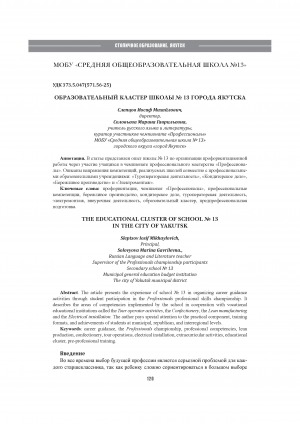
The article presents the experience of school N 13 in organizing career guidance activities through student participation in the Professionals professional skills championship. It describes the areas of competencies implemented by the school in cooperation with vocational educational institutions called the Tour operator activities, the Confectionery, the Lean manufacturing and the Electrical installation. The author pays special attention to the practical component, training formats, and achievements of students at municipal, republican, and interregional levels.
Слепцов, И. М. Образовательный кластер школы N 13 города Якутска / Слепцов И. М., Соловьева М. Г. ; МОБУ "Средняя общеобразовательная школа N 13" // Столичное образование. Якутск. - 2025. - N 3-4. - С. 120-123.
Количество страниц: 4 с.
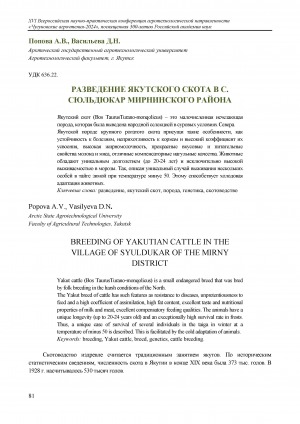
Yakut cattle (Bos TaurusTurano-monqolicus) is a small endangered breed that was bred by folk breeding in the harsh conditions of the North. The Yakut breed of cattle has such features as resistance to diseases, unpretentiousness to feed and a high coefficient of assimilation, high fat content, excellent taste and nutritional properties of milk and meat, excellent compensatory feeding qualities. The animals have a unique longevity (up to 20-24 years old) and an exceptionally high survival rate in frosts. Thus, a unique case of survival of several individuals in the taiga in winter at a temperature of minus 50 is described. Thisis facilitated by the cold adaptation of animals.
Попова, А. В.
Разведение якутского скота в с. Сюльдюкар Мирнинского района / Попова А. В., Васильева Д. Н. ; ФГБОУВО "Арктический государственный агротехнологический университет", Агротехнологический факультет // Чугуновские агрочтения : сборник научных статей по материалам XVI Всероссийской научно-практической конференции агротехнологической направленности "Чугуновские агрочтения", посвященной 300-летию Российской академии наук, 3-4 апреля 2024 г., г. Якутск. - Якутск : Издательский дом СВФУ, 2024. - С. 81-84.
Количество страниц: 13 с.
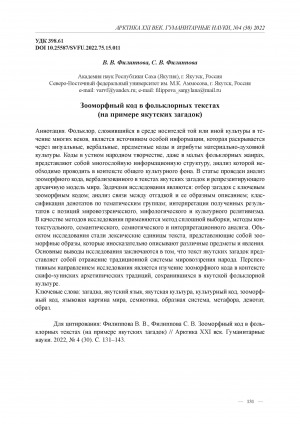
Folklore, which has developed among the bearers of a particular culture for many centuries, is a source of special information that can be revealed through visual, verbal, object-related codes and attributes of material and spiritual culture. Codes in folklore, even in its small genres, are considered a multi-layered information structure, which must be analyzed in the context of a general cultural background. In the article we investigate a zoomorphic code verbalized in the texts of the Yakut riddles and representing the archaic model of the world. The objectives of the study are the following: selection of riddles with a key zoomorphic code; analysis of metaphorical links between the answer and its figurative description; classification of denotations into thematic groups; interpretation of the results in the context of worldview, mythological and cultural relativism. Thus, at different stages we applied methods of unselected sampling, contextual, semantic, semiotic and interpretive analyses. The objects of the study were lexical units representing zoomorphic images that figuratively describe various objects and phenomena. The main conclusions of the study are that the texts of the Yakut riddles reflect the traditional system of the people’s worldview. A promising area of research is the study of zoomorphic code in the context of the ScythianHun archetypal traditions preserved in the Yakut folklore.
Филиппова, В. В. Зооморфный код в фольклорных текстах (на примере якутских загадок) / В. В. Филиппова, С. В. Филиппова ; Академия наук Республики Саха (Якутия), Северо-Восточный федеральный университет им. М. К. Аммосова // Арктика. XXI век. Гуманитарные науки. - 2022. - N 4 (30). - С. 131–143. - DOI: 10.25587/SVFU.2022.75.15.011
DOI: 10.25587/SVFU.2022.75.15.011
Количество страниц: 3 с.
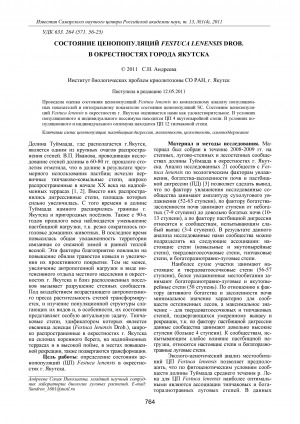
Evaluation of coenopopulations (CP) of Festuca lenensis has been made by complex analysis of population parameters and SC, the integral indicator of coenopopulation state. The state of Festuca lenensis coenopopulations in the vicinities of Yakutsk is appraised as satisfactory. The CP 4 (Elytrigia jacutorum steppe) is characterized by the state of population and individual pessimums. The CP 12 (Festuca lenensis steppe) is characterized by population and individual optimums.
Андреева, С. Н. Состояние ценопопуляций Festuca lenensis Drob. в окрестностях города Якутска / С. Н. Андреева ; Институт биологических проблем криолитозоны СО РАН // Известия Самарского научного центра Российской академии наук. - 2011. - Т. 13, N 1 (4). - С. 764-766.

Количество страниц: 10 с.
The article is devoted to the analysis of the historical experience of teaching the Yakut language to Russian-speaking and foreign audiences in Yakutia. An analysis of academic and methodological literature and the practice of implementing a methodological system on this problem in educational institutions of the republic shows that language education is constantly in search of innovative educational technologies and strives to solve interlingual and intercultural communication in a multicultural society. One of the leading Yakut scholars and methodologists who have developed an effective methodology for teaching the Yakut language as the state language was Professor Stepan Kolodeznikov, Doctor of Pedagogical Sciences, full member of the Academy of Pedagogical and Social Sciences. Thanks to Professor Kolodeznikov, since the beginning of the 21st century, the prestige of the Yakut language has noticeably increased and the interest of foreign linguistic researchers in the Yakut language has increased sharply. The purpose of this study is to analyze the academic and methodological thought on teaching the Yakut language as a non-native language in schools of the republic. To achieve this goal, we put forward the following tasks: an analysis of academic and methodological literature on the theory and didactics of interlingual and intercultural communication; coverage of the research activities of Professor Kolodeznikov, the founder of a unique academic school for teaching the Yakut language to Russian-speaking students, foreign students and foreign interns; generalization of the results of the work. A lot of work has been done to develop and systematize methods for teaching the Yakut language as a non-native language for Russian-speaking and foreign citizens. Thanks to our scholars and teachers, innovative educational technologies in language education have been developed, which contribute not only to mastering a non-native language, but also become a positive environment in solving interethnic relations in a multicultural society.
Захарова, Г. А.
Исторический опыт обучения якутскому языку в иноязычной аудитории / Г. А. Захарова, У. Р. Федорова ; Северо-Восточный федеральный университет им. М. К. Аммосова, Батагайская СОШ имени Н. Н. Тарского // Вестник Северо-Восточного федерального университета им. М. К. Аммосова. Серия "Алтаистика". - 2024. - N 4 (15). - С. 13-22. - DOI: 10.25587/2782-6627-2024-4-13-22
DOI: 10.25587/2782-6627-2024-4-13-22